

Chrome Plating Corrosion Resistance Explained for Truckers
A mirror-bright bumper can still rust through a small coating defect. Chrome plating corrosion resistance depends on the whole coating system, not just the shiny surface, a distinction supported by technical literature on chrome-plated steel. That matters when your truck spends winter hauling through salt spray instead of sitting at a show.
Whether you're shopping for a Peterbilt 389 bumper, a Kenworth W900 chrome bumper, or a Freightliner replacement, buy for your route first. The right base metal, nickel barrier, edge coverage, and fitment can mean less repair work without giving up the look you want.
Table of Contents
- Chrome Thickness and Layer Stack That Stop Rust
- Which Base Metal Holds Up
- Where Chrome Bumpers Fail First on the Road
- How Salt Tests Work and What They Prove
- How to Maintain Chrome Through Winter Salt
- Confirm the Coating Spec and Fitment Before You Order
Chrome Thickness and Layer Stack That Stop Rust
A bumper's rust resistance comes mainly from the nickel barrier and how the coating layers work together, not from how bright the chrome looks. Think of chrome as the hard, bright skin that helps resist surface wear, nickel as the water-resistant barrier beneath it, and steel as the body that rusts once moisture gets through. That's a useful buying model, although no plated barrier is damage-proof.
Decorative chrome isn't the thick industrial hard chrome used on working machine surfaces. Adding more of it doesn't automatically make a truck bumper better.
What Chrome Plating Corrosion Resistance Depends On
Historical decorative-plating guidance puts typical chromium deposits at 0.05–0.51 micrometers, or 2–20 millionths of an inch, and says hexavalent decorative chromium generally isn't plated above 0.635 micrometers, or 25 millionths of an inch, because excessive thickness can produce visible random cracking. A thicker deposit can help within a controlled process, but cracks can undermine both appearance and protection.
A mobile and static exposure study published by Products Finishing found that increasing crack-free chromium beyond approximately 0.25 micrometers added no protection in actual mobile service, while multilayer coating designs substantially improved corrosion protection. That's a strong reason to question a sales pitch built around extra chrome alone.
Layer structure matters as much as the thickness reading. A well-designed stack makes it harder for corrosion to travel straight through to the base metal.
Decorative nickel-chromium coating literature explains why multilayer nickel can outperform a single nickel layer of equal total thickness. In a triple-layer nickel system, semibright nickel, a sulfur-containing active interlayer, and bright nickel create controlled electrical differences. The active middle layer corrodes preferentially and spreads attack sideways, delaying penetration toward the steel.
Use Thickness as a Buying Screen
Technical plating guidance from Micrometal identifies 10–25 microns of nickel as a common component range and at least 25 microns, sometimes with a double-nickel structure, for severe outdoor or chloride exposure. Use those figures as screening guidance, not as a truck-bumper life guarantee. Ask whether measurements cover the actual bumper, especially its difficult shapes.
Layer thickness guidance by exposure level
| Exposure level | Nickel guidance | Chrome limit | Base metal to consider |
|---|---|---|---|
| Dry-state highway, light washing | 10–25 microns | 0.05–0.51 µm; stay under 0.635 µm for conventional hexavalent decorative plating | Carbon steel or 430 with regular washing |
| Northern winter road salt | 25 microns or more | Stay under 0.635 µm for conventional hexavalent decorative plating | 304 stainless preferred |
| Coastal or salt-air routes | 25 microns or more; double-nickel where offered | Stay under 0.635 µm for conventional hexavalent decorative plating | 304 stainless preferred |
| Galhor reference build | 35 microns, per the product specification | Ask for the measured limit below 0.635 µm; specified finish is triple-layer hexavalent chrome | 304, 430, or carbon steel by duty |
The table is a purchasing guide, not proof that every product meets these targets. Also, triple-layer chrome is not enough detail to establish a triple-layer nickel architecture. Ask what layers the manufacturer really applies.
Practical rule: A thick coating measured on the flat face won't protect a thin spot hidden inside a mounting cutout.
A bend or bare edge can become the starting point for concentrated corrosion. On carbon steel, a small exposed area beside more corrosion-resistant plating can suffer galvanic attack in salty water.
A specification that says only chrome plated leaves the important questions unanswered. Ask for nickel thickness in microns, chromium thickness control, the layer sequence, and coverage at edges and cutouts.
Which Base Metal Holds Up
The base metal sets your safety margin after the finish gets damaged. A scratch through chrome on carbon steel exposes metal that starts rusting on contact with road salt. The same scratch on stainless leaves a base that resists corrosion on its own.
The front face shows the appearance. Your order specification has to identify what sits underneath.
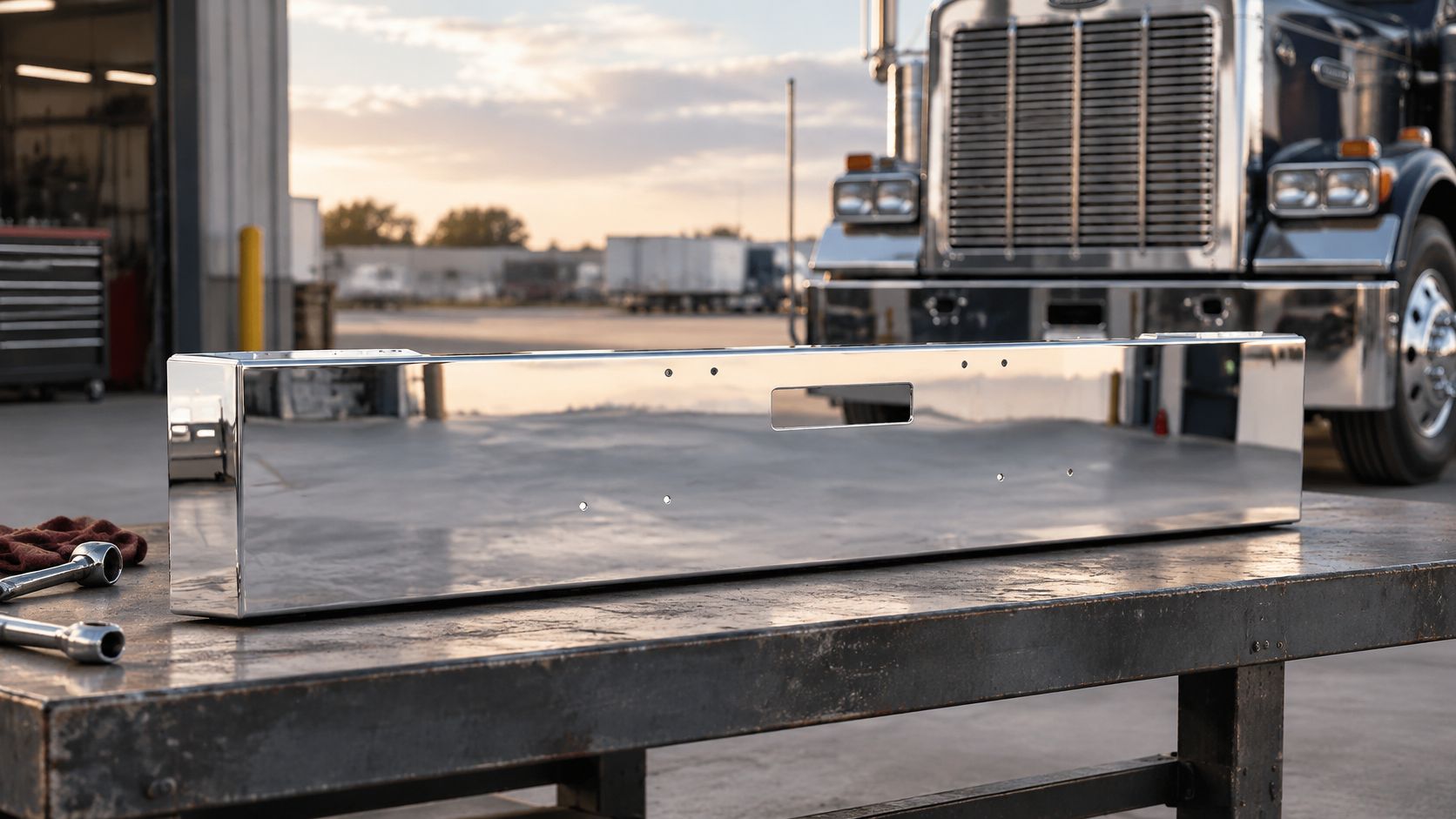
The World Stainless grade sheets distinguish 430, a ferritic grade with about 16–18% chromium and little or no nickel, from 304, an austenitic grade commonly associated with roughly 18% chromium and 8% nickel. Grade 304 offers more resistance to chloride pitting and crevice corrosion, but it still isn't immune to severe salt exposure.
Base metal comparison for chrome truck bumpers
| Base metal | Corrosion behavior | Best fit | Ship time |
|---|---|---|---|
| Chrome-plated carbon steel | Relies entirely on the protective finish; exposed steel rusts after a breach | Mild climates, budget-first buyers who accept more upkeep | Made-to-order, typically 4–6 weeks |
| Chrome-plated 430 stainless | Ferritic stainless with less margin against aggressive road salt than 304 | Mild to moderate service, appearance and cost priorities | In-stock flat bumpers can ship within 48 hours |
| Chrome-plated 304 stainless | Stronger resistance to chloride pitting and crevice corrosion | Salted northern states and coastal routes | In-stock flat bumpers can ship within 48 hours |
Those shipping windows describe the stated fulfillment categories, not every configuration. Confirm stock, material thickness, and dispatch timing for your selected bumper before scheduling installation.
Choose for the Route, Not Just the Price
For long winter runs through salted states, 304 is the stronger corrosion-focused choice. For mild service, 430 balances appearance and cost. Carbon steel works if you commit to keeping the finish intact, because every chip you ignore becomes a rust start.
The Chrome bumper for Freightliner Classic lists a mirror-polished chrome-plated steel construction with stainless steel 304/430 alternatives, and 35 microns of nickel beneath a triple-layer hexavalent chrome finish. Confirm the gauge and measured thickness in the written product specification for the variant you order, since material options differ across the range. Its standard-mount and blind-mount configurations are specified as direct bolt-on, without drilling or cutting, for the correct Freightliner Classic application.
Use the chrome-plated steel versus chrome-plated stainless steel comparison to narrow the material choice. Get the exact grade and thickness in writing rather than accepting stainless as a complete description.
Review the bumper presentation alongside the written specification.
Where Chrome Bumpers Fail First on the Road
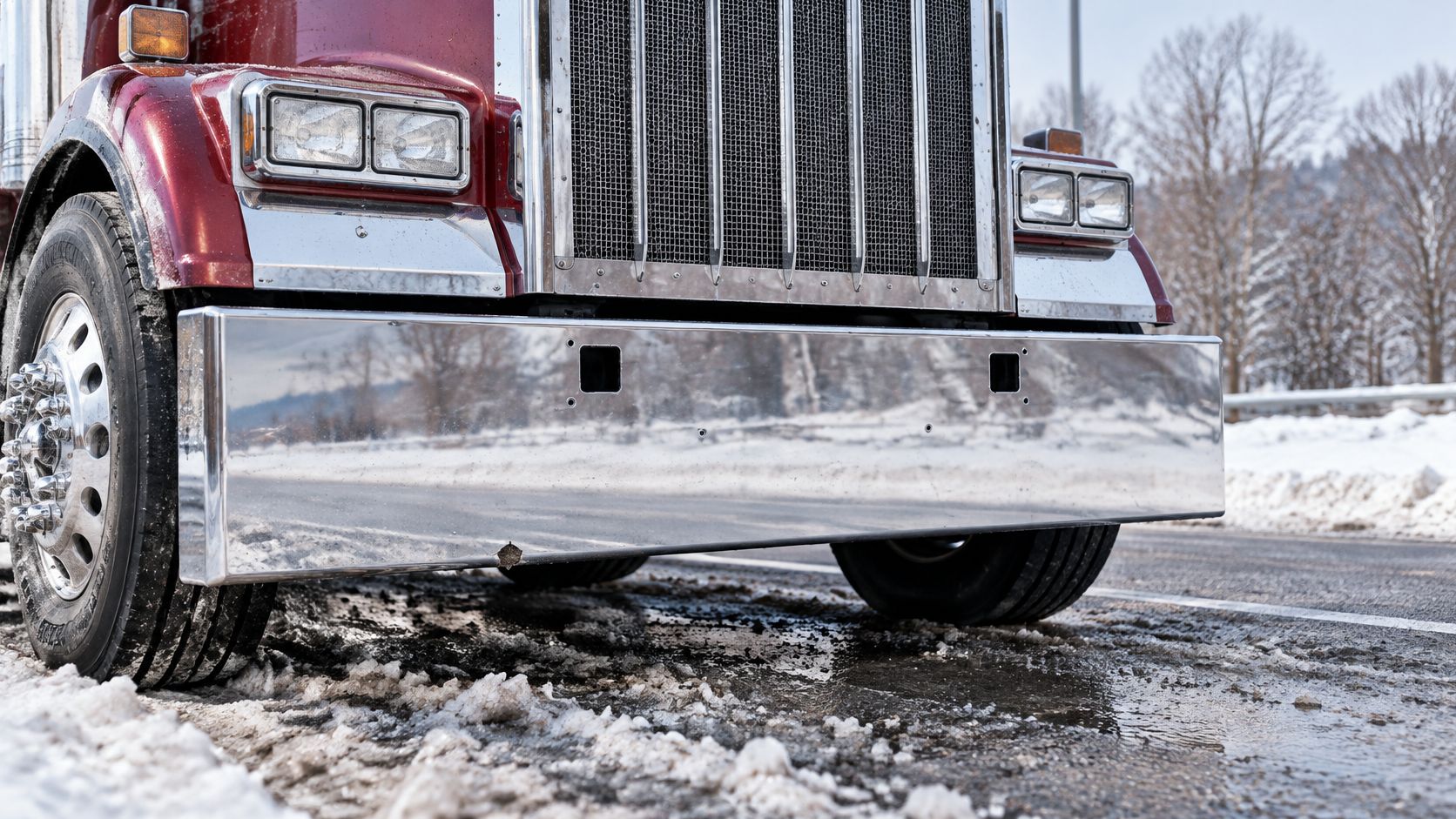
Say a Kenworth runs from Ohio to Pennsylvania in January. A stone chips the lower edge, and salt packs under a mounting bracket. By spring, the driver notices rust bleeding from the chip and flaking near the bracket.
An impact can break through both chromium and nickel, opening a path to the base metal. Chrome-plating process guidance also identifies pores, pinholes, cracks, poor cleaning, and substrate defects as ways moisture and road salt can reach beneath the finish.
The first warning is often local damage rather than a dull bumper face.
Chrome bumper failure points and early signs
| Failure point | Why it starts | Early sign | Fix (maintenance step) |
|---|---|---|---|
| Stone chip or scrape | Breaks chromium and nickel, exposing the layers below | Small rust dot spreading from the chip | Step 4: clean, dry, and seal the chip |
| Cutouts for tow, fog, and light holes | Cut edges may have thin or no plating | Rust ring around the opening | Step 3: inspect monthly; seal bare edges |
| Welds and bends | Uneven preparation or coating coverage at corners and weld beads | Haze or pitting along a seam | Step 3: inspect after every repair |
| Bolt holes and dissimilar fasteners | An electrically connected metal pair can form a galvanic cell when wet | Brown stain or bubbling near a fastener | Step 7: replace rusted fasteners and isolate metals |
| Trapped road salt under brackets | Moisture stays in crevices | Rust bleed at bracket edges | Steps 1 and 2: rinse salt and dry brackets |
Inspect the Hidden Surfaces
Look behind the lower lip and around the backs of openings, not just across the mirror finish. Use a flashlight and inspection mirror to check bracket contact areas before installation. Photograph suspicious roughness or bare edges before mounting the bumper.
A rust-colored streak doesn't always prove the bumper itself has failed. A corroding washer or bracket can stain an otherwise sound face, so locate the source before buying a replacement.
Don't accept an unfinished cutout just because the flat face has an impressive plating specification.
Repairs deserve the same attention as factory openings. Grinding a hole wider, welding a bracket, or cutting a new light opening can remove the protective system where the truck needs it.
Avoid adding holes after finishing unless the manufacturer approves the work and explains how to protect the exposed material. A cosmetic wipe over a fresh cut isn't equivalent to restoring the original plating.
Uniform, unbroken coverage and protected edges are more useful than a higher nominal thickness with bare cut edges. For a working Peterbilt, Kenworth, Freightliner, or International, inspect the places that collect grit and salt before judging the shine.
How Salt Tests Work and What They Prove
A supplier saying a bumper was salt-spray tested hasn't given you enough information to compare it. You need the method, exposure hours, specimen shape, and pass criteria.
ASTM B368 covers CASS testing for decorative nickel/chromium and copper/nickel/chromium coatings; typical conditions use pH 3.1–3.3, approximately 49–50 °C, and copper chloride to intensify attack. The standard defines the exposure environment, not a universal test duration or acceptance limit.
Corrosion test methods compared for truck bumpers
| Test | What it simulates | Typical conditions | What it proves |
|---|---|---|---|
| Neutral salt spray, ASTM B117 | Constant salt fog | Neutral salt solution in a fog chamber | Broad screening; limited value by itself for ranking decorative chrome |
| CASS, ASTM B368 | Aggressive acidic salt fog | Acidified salt solution, elevated chamber temperature, copper chloride added | A more targeted accelerated screen for decorative nickel-chrome |
| Outdoor exposure, including Kure Beach and Detroit-roof programs | Actual weather, with site-specific pollutants and salt exposure | Racked panels outdoors for a defined exposure period | Real outdoor performance, but slowly and only for the conditions represented |
| Cyclic corrosion | Repeated wet and dry exposure | Alternating salt, humidity, and drying | Response to changing moisture conditions that steady fog doesn't reproduce |
Read the Report, Not the Badge
A useful report lets a fleet maintenance manager understand exactly what failed and where. Request these details before paying more for a corrosion claim:
- Exposure hours: The actual test duration, not just the chamber's name.
- Specimen shape: A flat coupon, formed bumper section, or complete bumper.
- Red-rust initiation: When substrate corrosion first appeared and its location.
- Blistering: Whether the coating lifted or formed bubbles.
- Scribe creep: How far corrosion spread from an intentional scratch.
- Edge performance: Whether cut edges, mounting holes, and light cutouts were included.
The quality-control procedures guide provides a useful starting point for questions about inspection and qualification. Ask for results that identify the actual material and finish you're ordering.
Buying check: Test hours are not road-service years. Don't accept a direct conversion.
For a fair comparison, ask suppliers to use the same CASS exposure, preconditioning, and defect criteria for carbon steel, 430, and 304. A result from an untouched flat panel shouldn't be compared with a result from a scratched, formed bumper.
Combine laboratory exposure with cyclic testing and field inspections. Stone impacts, trapped salt, and fastener interfaces can create damage that a clean laboratory coupon never experiences.
How to Maintain Chrome Through Winter Salt
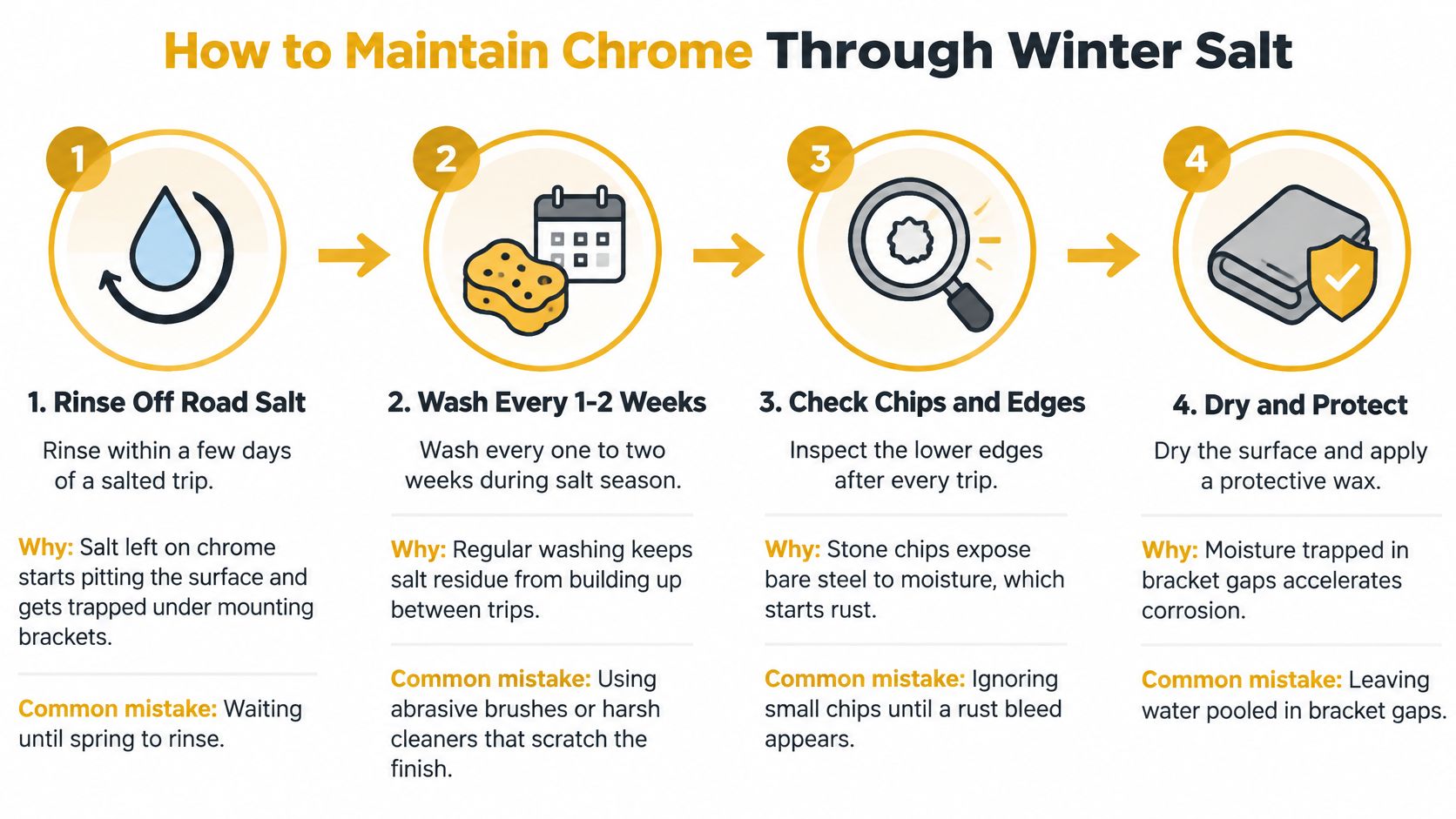
Winter care should remove salt, keep crevices dry, and catch damage before it spreads. It won't rebuild missing nickel or restore loose plating, but it can keep a small defect from going unnoticed.
Use this visual as a quick wash-bay reminder, then follow the fuller routine below.
A Practical Winter Routine
- Rinse away road salt promptly. As a practical maintenance schedule, rinse within a few days of a salted trip and wash every one to two weeks during salt season. Flush the back face and bracket areas, not just the visible front; waiting until spring leaves residue sitting against the finish.
- Dry the bumper and hidden gaps. Use clean microfiber towels on the face and accessible openings, then remove standing water around brackets. Don't leave a wet sponge or cloth packed into a crevice.
- Inspect chips, seams, and openings. Check the lower edge after salted trips, make a monthly close inspection, and inspect again after any repair. Look for rust rings, lifting edges, and staining at bolt holes; protect exposed cut edges rather than polishing around them.
- Clean, dry, and seal small chips. Remove loose contamination gently and use a localized touch-up coating suitable for the exposed metal and adjacent chrome. A wax film alone isn't a repair for bare steel, and sealing over damp rust can hide continued attack.
- Use mild soap and soft wash tools. Rinse grit away before wiping with a clean mitt. Abrasive pads and acid cleaners can damage the mirror finish, so don't use them to chase a stubborn stain.
- Polish gently during salt season. A monthly check and treatment with a non-abrasive chrome-compatible polish is a reasonable routine where the finish allows it. Follow the chrome-bumper polishing guide, and don't assume polishing seals holes or restores lost plating.
- Deal with corroding hardware. Replace rusted fasteners with hardware approved for the mounting application, and use approved isolation where dissimilar metals meet. Don't add soft washers that compromise clamp load or substitute decorative bolts for specified mounting hardware.
- Keep a defect record. Save dated photos, the defect location, purchase documents, and notes about cleaning or repair. Those records help the supplier assess a manufacturing-defect warranty claim, but they don't guarantee coverage for impact or maintenance damage.
Know When Touch-Up Is No Longer Enough
Call a plating or truck body shop when rust spreads beneath the chrome, bubbles appear, or the finish starts lifting. Don't grind the visible face in an attempt to stop hidden corrosion.
A shop can assess whether stripping and replating makes sense or whether replacement is the better value. For a working truck, compare that repair cost and downtime with the cost of a correctly specified replacement.
Confirm the Coating Spec and Fitment Before You Order
Labels such as triple chrome and premium chrome aren't complete specifications. Before ordering, get clear answers to these questions:
- Nickel barrier: What thickness is specified, and where is it checked?
- Chrome process: What chemistry, layer sequence, and thickness limit are controlled?
- Base material: Is it carbon steel, 430, or 304, and what is the gauge or measured thickness?
- Test evidence: Which method, hours, and defect criteria support the corrosion claim?
- Difficult surfaces: Are edges, mounting holes, and cutouts coated and evaluated?
- Warranty: What manufacturing defects are covered, and what exclusions apply?
- Fulfillment: Is your exact configuration in stock, and when will it ship?
Match the Bumper to the Truck
Confirm the make, model, model year, mounting pattern, and cutout layout for your Peterbilt, Kenworth, Freightliner, or International. Model-family names alone aren't enough to establish compatibility.
For an 18 inch drop bumper, check ground clearance at driveway transitions and loading areas before choosing the deeper profile. Compare tow, fog-light, and auxiliary-light openings with your existing equipment, and choose between polished chrome and polished stainless deliberately.
Use compatible mounting hardware and approved isolation at dissimilar-metal interfaces. Don't force mounting bolts into misaligned holes or cut a finished bumper to correct an ordering error.
California's proposed Rule 1469 materials/par1469_pdsr_20250822.pdf?sfvrsn=72f26d7e_5) address a proposed transition away from decorative hexavalent-chrome processes. Regulatory compliance and corrosion performance are separate questions, so ask whether test methods and acceptance criteria remain comparable after a chemistry change.
For salted northern routes, favor 304 with a nickel barrier specified for severe exposure. For mild routes, 430 can be a sound choice when coverage, fitment, and upkeep are right.
Galhor Inc. offers configurable chrome-plated carbon-steel, 430 stainless, and 304 stainless truck bumpers, so you can match the material and finish to your route. Visit Galhor Inc. to confirm fitment and order now; in-stock stainless flat bumpers can ship within 48 hours across the United States. Get yours today after confirming your coating specification, cutouts, and dispatch date.