

International 9400 Bumper: Fit, Finish, and Value Guide
You're sitting on the shoulder with a bent front bumper, a load booked, and a shop telling you they can't match the truck by model name alone. That's the trap with an International 9400 bumper. It isn't just chrome, it's fitment, bracket location, cutouts, and downtime all tied together, and a wrong click can turn a simple repair into a freight headache.
Table of Contents
- Why Your International 9400 Bumper Choice Matters
- Identifying Your 9400 Generation Before You Order
- Comparing Chrome Steel, Stainless 430, and Stainless 304
- Measuring and Verifying Fitment Before You Buy
- Installing a Bolt-On Bumper the Right Way
- What a Front Bumper Does and Does Not Do
- Lead Times, Freight, and the Full Cost of Downtime
- Your 9400 Bumper Buying Checklist
Why Your International 9400 Bumper Choice Matters
A driver drags a nose over a low dock plate, hears the crunch, and now the bumper hangs crooked while the truck still has to roll by morning. The first mistake is treating the replacement like a trim piece. On a Class 8 truck, the bumper is a mounting surface, a clearance point, and a visual signature all at once.
The second mistake is guessing on fit. The International 9400 launched in 1990 with a set-back front axle and a longer, sloped hood, while the 9300 stayed around as the classic-style option. That split is why one “9400 bumper” can land right and another can miss the brackets, openings, or hood line entirely. The later rename to 9400i and the 2006 shift to the ProStar matter too, because a buyer who skips the year can buy the wrong part.
Practical rule: If you don't know the truck's year, axle position, and exact front-end layout, you don't know enough to order a bumper.
That's why this guide stays practical. It treats fit, material, finish, and downtime as separate decisions, because that's how real repairs get made in the shop, not on a product page.
Identifying Your 9400 Generation Before You Order

Know the truck before you buy the part
A 1991 International 9400 and a 2005 9400i can wear the same badge and still need different bumper hardware. The model-year trap is real. The truck's front-end layout, axle position, and hood line decide whether a bumper lands cleanly or fights the brackets.
The International 9400 launched in 1990 as an aerodynamic Class 8 highway truck. It started with the Transtar/Paystar cab base, then moved to a set-back front axle so International could run a longer, sloped hood. That change is the reason fitment has to be verified truck by truck, not guessed from the nameplate. By 2000, the model name became 9400i, and by 2006 the ProStar took over as the newer highway platform (International Trucks history).
A bumper follows the metal in front of the grille, not the marketing name on the door. A 2005 highway tractor with a 12,000-pound front axle, 40,000-pound rear axles, a 230-inch wheelbase, a Cummins ISX rated at 435 horsepower, and a 72-inch sleeper shows how the later 9400 platform was set up for long-haul work (Selking International 2005 9400 listing). That front-end package is not the same fit as an earlier truck with a different axle set, wheelbase, or hood profile.
What to verify on the truck
Before you order, check the truck in this order:
- Model year and badge: Confirm whether it is a 9400 or 9400i.
- Axle position: Set-back and set-forward trucks do not use the same bumper geometry.
- Front-end shape: Hood slope, grille line, and bracket location all matter.
- Mounting structure: Measure where the bumper bolts to the frame.
- Cutouts and openings: Tow hooks, fog lights, steps, and radar openings must line up.
A product page can still look clean and be wrong for your truck. A Steel chrome bumper is listed as 10-gauge chrome-plated steel with a mirror-polished finish and direct bolt-on installation, but that only helps if the generation and front-end layout match first.
Comparing Chrome Steel, Stainless 430, and Stainless 304
For an International 9400 bumper, the material choice should match the route, the weather, and how long you plan to keep the truck. Chrome alone does not tell you much. The base metal under the finish decides how well the bumper handles road salt, winter grime, and the slow wear that comes with real use.
Pick material for your route, not your ego
Galhor's lineup follows the same logic good truck shops use every day. Chrome-plated carbon steel fits buyers who want the look and direct-fit convenience without paying for a more corrosion-resistant base. Chrome-plated stainless 430 sits in the middle. It gives a practical balance of cost and durability for many fleets. Chrome-plated stainless 304 is the premium pick for trucks that live in harsh weather or spend their lives on salted roads.
| Material | Corrosion Resistance | Typical Lead Time | Best Fit |
|---|---|---|---|
| Chrome-plated carbon steel | Good for fair-weather and controlled use | Longer on made-to-order units | Budget-minded owners, show trucks, standard replacements |
| Chrome-plated stainless 430 | Better than carbon steel, solid daily-driver choice | In-stock units can move faster | Fleets and owner-operators who want a practical middle ground |
| Chrome-plated stainless 304 | Strongest corrosion resistance of the three | In-stock units can move faster | Northern routes, salted roads, long-horizon ownership |
That is the cleanest way to judge it. A truck that runs hard winters should get 304 if you want to keep corrosion from turning a bright bumper into a shop job later. A truck that needs a professional front end and has to stay on budget can use 430 without overspending. Carbon steel makes sense for a cosmetic refresh or for trucks that do not face punishing weather.
For a deeper breakdown of how 430 and 304 stainless steel behave under road salt, see this 430 vs 304 stainless steel comparison.
Shop-floor rule: Pick the metal that fits the truck's duty cycle. A pretty bumper that rusts early costs more in the long run.
If you are buying an International 9400 bumper, do not stop at the chrome finish. Confirm the base material on the product page. That detail tells you whether the bumper is built for budget, balance, or maximum resistance to corrosion.
Measuring and Verifying Fitment Before You Buy
Measure the old bumper, not the catalog photo
The easiest way to waste money is to trust the part name and ignore the dimensions. A common International 9200/9400 replacement bumper is listed at about 98 inches long, 18 inches high, and 31 inches deep, with a shipping weight of about 125 pounds. Another listing shows a 94-inch length and 21-inch height, which is enough variation to break a bad assumption fast (Big Truck Hoods).
There are also fitment listings for 1997-and-newer 9400 direct-mount bumpers at roughly 13 inches high and about 110 pounds, plus other assemblies that run 12 or 16 inches and may include different tow-hook, step, fog-light, or radar openings (Mad Max Truck Parts). That spread is the whole reason you measure first and order second.
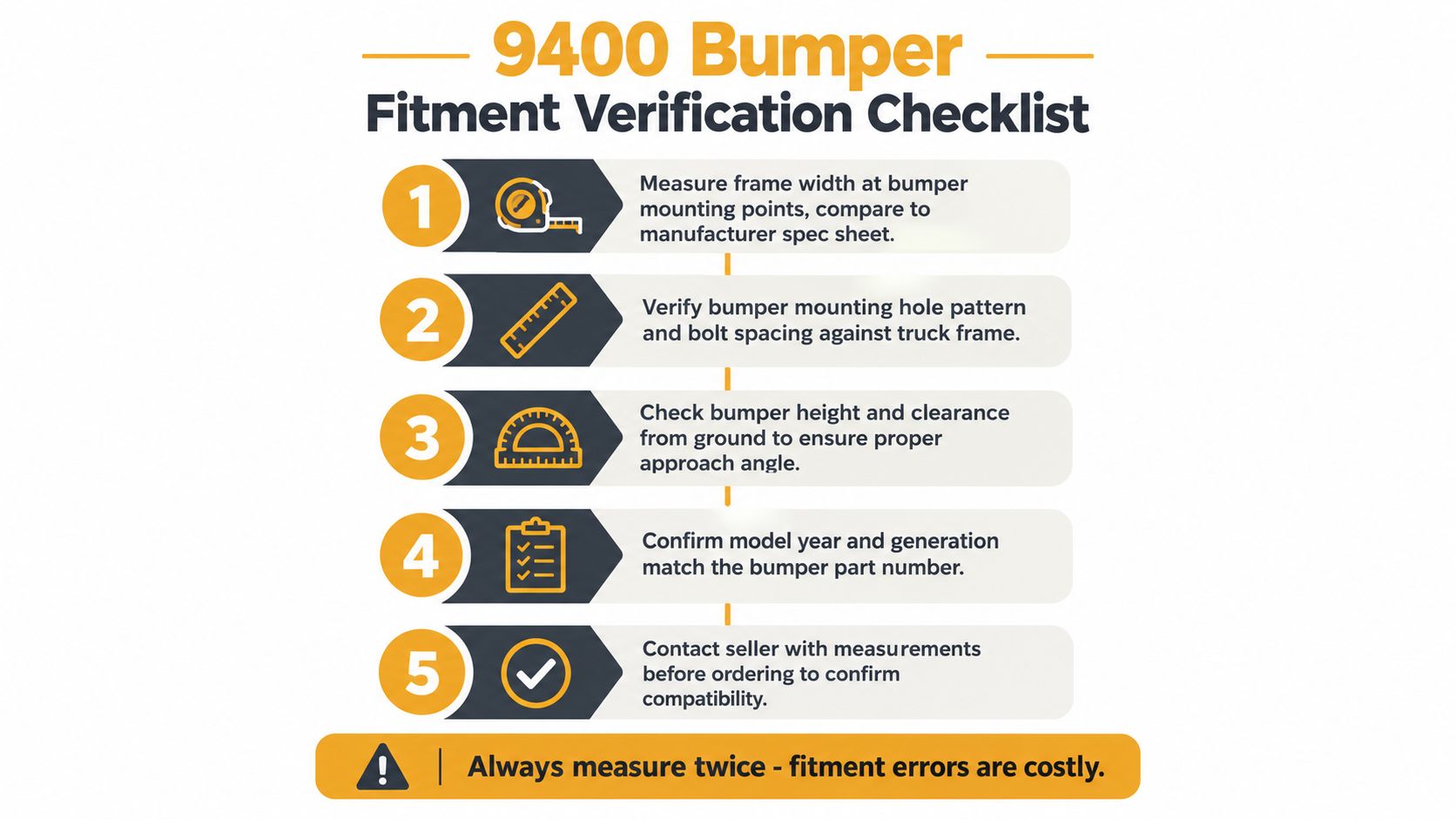
Run this shop checklist
- Record overall width and height: Don't guess from the grille. Measure the actual bumper.
- Check frame-rail spacing: A direct-bolt bumper still has to meet the rails correctly.
- Log every opening: Fog lights, tow hooks, steps, and radar cutouts all matter.
- Confirm axle position: Set-forward and set-back trucks change wraparound geometry.
- Ask for a drawing when the dimensions look close: Freight on a 125-pound part is too expensive to treat casually.
If the bumper fits the model name but not the frame, it's the wrong bumper.
This is also where a supplier drawing saves you from a return. If the measurements line up on paper but the cutouts don't, stop there. Ordering a heavy bumper before you've matched the frame and openings is how shops end up paying freight twice.
Installing a Bolt-On Bumper the Right Way
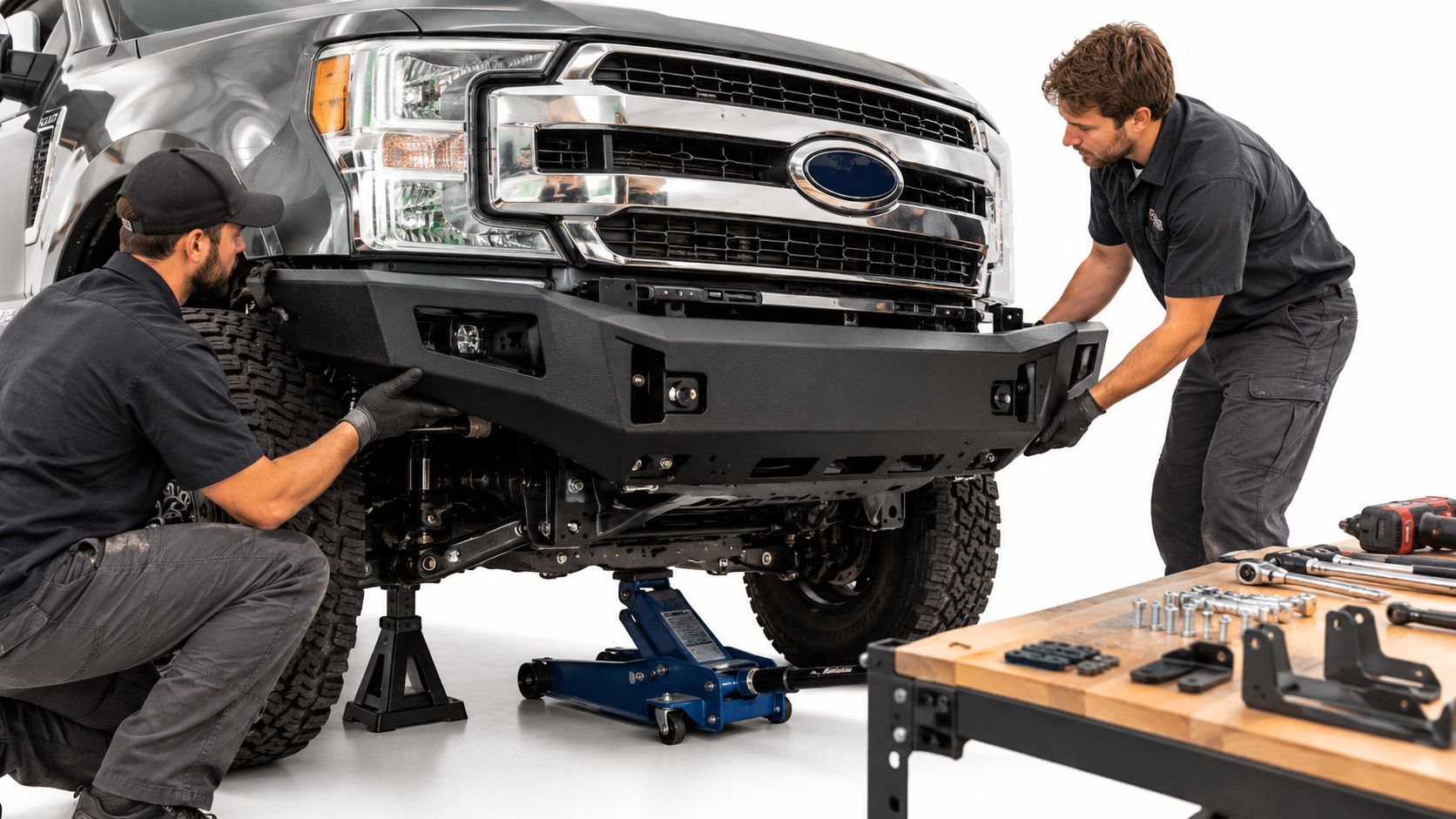
A bumper in the 80 to 120 pound range deserves support, not muscle. One configurable 9400/9200 listing also shows a 185-pound part in a 96 × 26 × 26-inch shipping package (4 State Trucks). Use a floor jack, a lift, or a second technician. Dragging it into place by hand is how you scar chrome, bend mounting ears, and build a shake into the front end.
Start every fastener loose. Center the bumper to the grille and frame before you snug anything down. Then verify clearance at the hood, tow points, lamps, and front tires before final torque. That order saves time and prevents the common mistake of locking in a crooked fit.
A clean bolt-on swap usually runs 2 to 4 hours in the shop. Seized hardware, collision distortion, or wrong brackets stretch the job fast. A straight install sequence is only useful if the bumper, brackets, cutouts, and height match the truck you own. A direct-bolt bumper still needs careful alignment, and a small offset shows up every mile.
Read the install process before you start, then line up your tools and help.
Keep the finish alive
- Handle with support: Use a jack or helper so the shell does not twist.
- Protect the chrome: Never drag the face across concrete or metal.
- Tighten in stages: Snug it, check alignment, then torque it down.
- Recheck after the first run: Road vibration exposes bad bracket work quickly.
What a Front Bumper Does and Does Not Do
The Government Accountability Office says U.S. federal rules require rear underride guards on most large trucks, but not front or side underride guards (GAO report). That's the line owners need to understand. A front bumper is not a regulated underride device, and chrome finish doesn't change that.
Use the bumper for the job it was built to do
A 9400 front bumper does a few things well. It gives you a mounting surface for lights and accessories, helps shield the grille from minor knocks, and sets the tow and step geometry at the nose of the truck. That's useful work, especially on a highway tractor that lives in traffic, weather, and tight yards.
It does not replace crash structure. It won't turn a chrome bumper into a certified front underride solution, and it shouldn't be sold that way. If you're modifying brackets or adding accessories that change the load path, talk to the truck manufacturer, a fleet safety engineer, and the rules that apply in your state or operating area.
A bumper can look right and still be the wrong part for the job. That's why appearance should stay separate from safety claims. The front end needs to fit, mount cleanly, and survive daily use, but it shouldn't be mistaken for equipment it isn't.
Bottom line: Buy the bumper for fit and function. Don't expect it to do regulatory work it was never designed to do.
Lead Times, Freight, and the Full Cost of Downtime
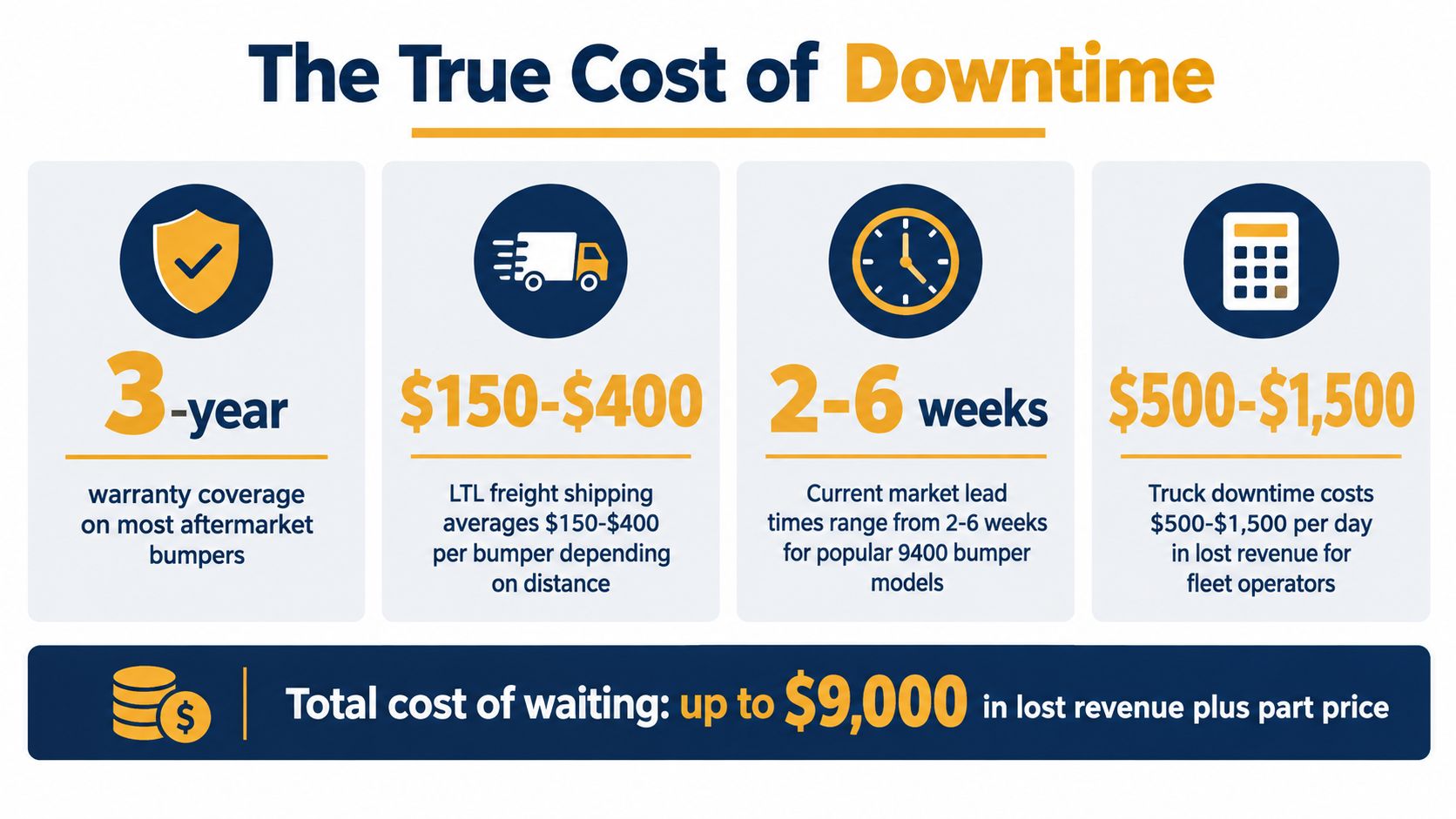
The part price is only half the bill. On a working truck, freight and lead time can cost more than the bumper itself if the unit sits. Galhor's in-stock 430 and 304 flat bumpers can ship within 48 hours, while made-to-order carbon steel units typically ship in 4 to 6 weeks. That gap matters when the truck needs to be rolling, not waiting on a dock. For the freight side, read Galhor's LTL freight shipping explainer.
Buy the time you need, not just the metal
If a truck sits because the wrong bumper was ordered, the shop loses more than a part swap. It loses route time, dispatch flexibility, and customer trust.
LTL freight is part of the math too. A bumper around 125 pounds may need lift-gate planning, and larger packaged units take shop space before they are even uncrated. Warranty coverage for manufacturing defects still only protects the part. It does not recover the revenue lost while the truck is out of service.
Here is the buying mindset I trust:
- If the truck must roll soon: Pick the shortest realistic lead time.
- If winter roads are brutal: Put corrosion resistance first.
- If the bumper may take repeat abuse: Choose repairability and fast replacement.
- If the truck is a showpiece: Finish and appearance can matter more.
Do not chase the lowest sticker price and then pay for delays, re-freight, and missed loads. Compare the part, the shipping, and the downtime in one shot. That is the actual cost.
Your 9400 Bumper Buying Checklist
Start with the truck's year and call out 9400 or 9400i clearly. Then choose the material that fits your route, measure the old bumper and frame, and match every cutout before you order. After that, plan the install, the freight handling, and the downtime window like a working truck depends on it, because it does.
If you want a clean direct-bolt replacement, fast U.S. shipping when the part is in stock, and a bumper built around real fitment data, shop with a supplier that treats the truck like a truck. Don't buy blind, and don't let a model name do the measuring for you.
If you need a direct-bolt bumper built around the right year, fitment, and finish, Galhor Inc. makes chrome bumpers for Class 8 trucks with configurable cutouts and material choices that match real routes. Visit Galhor Inc. to check options for your International 9400 bumper and order the part that fits the truck you run.