

Kenworth Aftermarket Parts Guide
Your Kenworth is sitting in the yard, the load is booked, and the clock is already eating your profit. That's when Kenworth aftermarket parts stop being a shopping decision and turn into an uptime decision. A bumper, bracket, or mounting kit has to fit right, hold up in bad weather, and get the truck back in the lane without a second trip to the shop.
Table of Contents
- The Scale of Kenworth Aftermarket Demand
- Calculating the True Cost of Replacement Parts
- Choosing the Right Bumper Material for Your Routes
- Verifying Fitment and Avoiding Installation Headaches
- Understanding Chrome Finishes and Federal Safety Rules
- Navigating Shipping Lead Times and Warranty Support
- Your Action Plan for Upgrading Your Truck
The Scale of Kenworth Aftermarket Demand
A Kenworth on the road today can wear a front end that looks nothing like the truck beside it. That is the reality behind Kenworth aftermarket parts. They have to cover different model years, cab setups, and working roles. Kenworth was incorporated in Seattle on January 22, 1923, and its first truck left the line in March of that year, which helps explain why the parts mix is so broad. By 1923, it had produced 78 six-cylinder gasoline trucks, and by 1925 production had climbed to nearly two trucks per week, with customization built into the business from the start. Kenworth's anniversary history traces that long buildup.
That history shows up in the shop. A long-hood classic, a regional tractor, and a newer aerodynamic truck may all need different mounting points, cutouts, and clearance checks. Kenworth also made early changes that widened the range still running today, including standard diesel engines in 1933 and its first sleeper cab in 1936. By its 90th anniversary in 2013, Kenworth reported more than 900,000 trucks cumulatively, and by 2023 it reported more than 1 million Class 5 through Class 8 and super-heavy-duty models produced. That installed base is why the aftermarket stays busy.
Practical rule: the older and more customized the truck, the more exact fitment matters.
Why that matters at the counter
A truck down on the lot needs a part that solves the problem the first time. A bumper or bracket that misses the mounting points does more than waste money. It burns a day or more of freight time, and sometimes the shop ends up ordering again. Kenworth truck parts are easier to evaluate when fitment, mounting style, and clearance are laid out plainly, because the question is not what fits the badge. It is what gets the truck back to work without another stop.
Calculating the True Cost of Replacement Parts
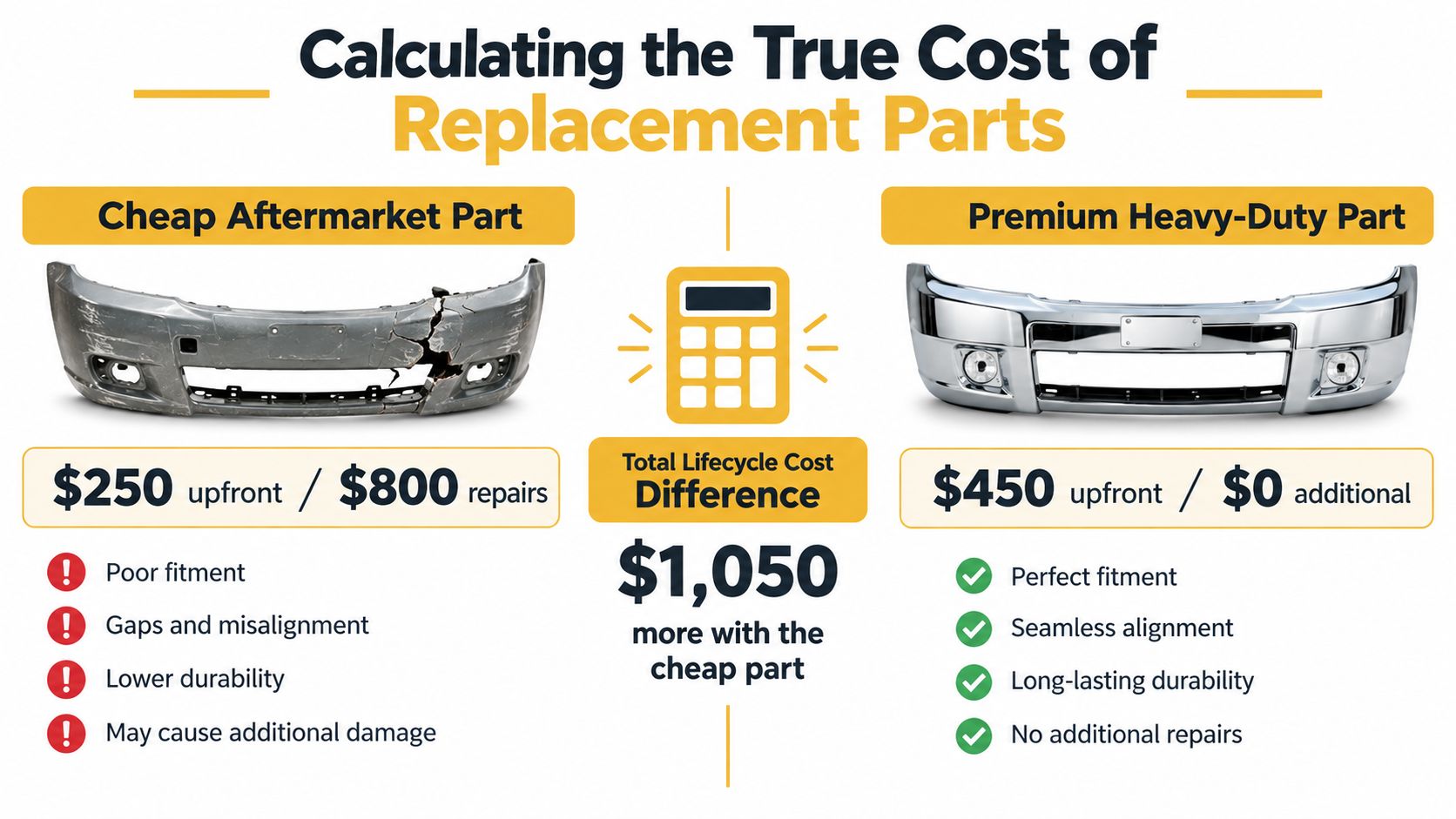
Sticker price is the first number people see, but it's rarely the total cost. A cheaper bumper that needs rework, returns, or another shop visit can end up costing more than the part that bolts on cleanly the first time. For fleets, the actual bill includes freight, labor, possible downtime, and the risk of repeating the job.
The cost you don't see on the invoice
If a truck sits because a part doesn't line up, the shop bay becomes expensive real estate. That's why I look at fitment certainty, installation time, and expected service life before I look at the tag. A direct bolt-on part with clear mounting points is often the cheaper part in practice, even when the box price is higher.
The same logic applies to Chrome bumper for Kenworth W900, which is listed as a direct bolt-on Kenworth W900 bumper with standard mount and blind mount options, a mirror-polished finish, and options in chrome-plated steel or 3 mm chrome-plated Stainless Steel 304/430. That kind of specification matters because the shop time comes down to what fits, not what looks good in a product photo.
What to compare before you buy
- Purchase price: what you pay today.
- Installation certainty: whether the part uses the truck's existing mounting points.
- Rework risk: whether a bracket, cutout, or hole pattern has to be modified.
- Shipping timing: whether the truck can wait for a made-to-order part.
- Replacement interval: how often the truck will need the same job again.
The cheapest part is only cheap if it gets you back on the road fast and stays there.
That's the full lifecycle view. A premium part doesn't win because it sounds fancy. It wins when the truck starts earning again without extra labor, extra freight, or extra headaches.
Choosing the Right Bumper Material for Your Routes
Material choice is where a lot of buyers make a false economy. Chrome-plated carbon steel looks sharp and works for some builds, but it's not the same as stainless when the truck lives in salt, slush, or wet road spray. 430 stainless steel sits in the middle. 304 stainless steel is the stronger long-term play for harsh weather and corrosive routes.
Match the metal to the lane
If the truck runs fair-weather highway miles and the owner cares about a polished look, carbon steel can make sense. If the truck sees mixed duty, regional hauling, or frequent wash cycles, 430 stainless gives more corrosion resistance than chrome-plated steel while keeping the budget in check. For winter salt, coastal air, or muddy job sites, 304 stainless is the tougher choice because it resists rust-through better over time.
The best way to shop this is to think like a mechanic, not a catalog browser. Ask where the truck runs, how often it gets washed, and whether the bumper will be treated like show hardware or working hardware. For a deeper material breakdown, see stainless steel vs carbon steel.
Bumper Material Comparison
| Material | Corrosion Resistance | Best Use Case |
|---|---|---|
| Chrome-plated carbon steel | Lowest of the three, depends heavily on finish care | Budget-conscious builds, show trucks, and drier routes |
| 430 stainless steel | Better than chrome-plated steel, less than 304 | Regional fleets, mixed weather, frequent cleaning |
| 304 stainless steel | Strongest long-term corrosion resistance here | Winter salt, coastal humidity, wet construction work |
A few points matter every time, no matter the grade:
- Thickness: thicker material can help with dent resistance, but only if the bumper still fits the truck correctly.
- Finish: chrome and polish affect appearance, but they don't replace the need for the right base metal.
- Maintenance: every finish lasts longer when the truck gets cleaned and inspected on schedule.
A truck that lives hard needs a material that can keep up. A pretty bumper that pits early is just expensive décor.
Verifying Fitment and Avoiding Installation Headaches
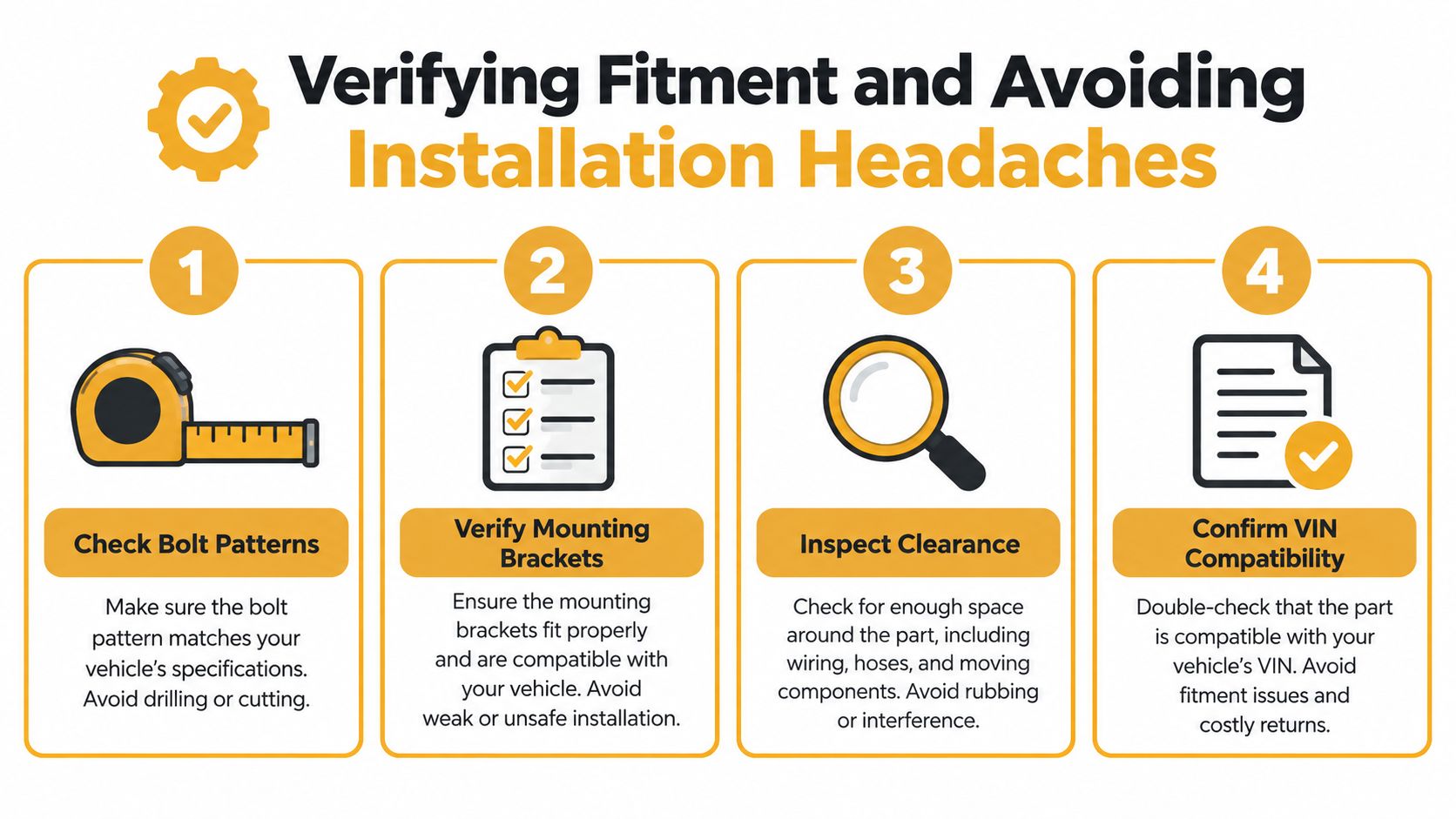
A bumper that almost fits is a wasted purchase. If the truck needs drilling, cutting, or custom brackets, the “deal” usually disappears fast. The right part should line up with the model year, chassis layout, and factory cutouts before it ever gets near the bay.
What to verify before you order
- Check the VIN and build details: the VIN tells you what the truck is, not what it looks like after years of use.
- Match the bolt pattern: if the mounting holes don't align, the part is wrong, full stop.
- Confirm the brackets: a direct bolt-on bumper should use the truck's existing hardware or a known bracket set.
- Inspect cutouts and clearance: tow hooks, fog lights, sensors, and license plate space all need to line up.
If you have to force the part to fit, you bought the wrong part.
The big trap is assuming one Kenworth bumper fits all years of a model line. It doesn't. Small changes in mounting points, front-end accessories, and sensor packages can turn a clean install into a fabrication job. That's why I always tell owners to compare the truck's actual setup against the bumper's cutouts before the order goes in.
How to keep the job simple
A clean install usually comes from three things: the right part number, the right hardware, and the right configuration. If the truck has tow hooks or lights, the bumper needs the matching openings. If it's a direct bolt-on design, the shop should be able to mount it without drilling the frame or chasing alignment problems.
Proper parts planning makes the difference. A bumper that lands on the truck ready to mount is a better part than one that looks similar but needs a fabricator's help.
Understanding Chrome Finishes and Federal Safety Rules
Chrome gets a lot of attention because it shines, but shine alone doesn't make a bumper good. A bumper is still a structural component, and finish quality matters because peeling, cracking, or poor adhesion usually shows up right when the truck takes a bump or catches road grit. A heavy-duty hexavalent triple-layer chrome process with nickel backing holds up better than a cheap flash finish, because the surface has more going for it than just mirror looks.
Finish is more than shine
A polished bumper can still fail if the mounting support is weak. That's why thickness, bracket design, and surface construction matter together. A front bumper on a Kenworth, Peterbilt, Freightliner, or International has to look good and stay put.
Federal rules back that up. Under 49 CFR §393.203, a commercial vehicle's front bumper can't be missing, loosely attached, or sticking out in a way that creates a hazard. That means the bumper has to sit square, use the right mounting points, and avoid sharp or exposed edges. Buyers also need to verify cutouts for tow hooks, sensors, fog lights, and license plates before they place the order. The federal rule makes the safety point clear.
What to look for in the shop
A proper bumper should do three things at once:
- Mount securely with no looseness.
- Clear the truck correctly without protruding into a hazard.
- Hold its finish after normal road abuse.
A thicker bumper can help with dent resistance, but extra thickness only helps if the part is built for the exact truck. If the mounting bracket design is weak, the finish and the steel both suffer.
The surface matters after the first scrape, not just on install day. A bumper that keeps its plating and shape after minor contact is the one that saves time later.
A bumper that passes the eye test but fails the mount test is the wrong bumper.
Navigating Shipping Lead Times and Warranty Support
When a truck is down, speed matters almost as much as fit. In-stock parts can get a unit back to work fast, while custom builds may need a longer wait because they're made to order. That's why lead time should be part of the buying decision from the start, not an afterthought after the old bumper is already off the truck.
What fast delivery really changes
If the truck has a tight schedule, a part that ships quickly can save a load. Galhor Inc. offers in-stock stainless steel 430 and 304 flat bumpers that can ship within 48 hours, while made-to-order carbon steel units typically ship in 4 to 6 weeks. That difference changes how a fleet plans repairs, especially when the truck can't sit around waiting for a custom unit.
The other half of the equation is warranty support. A real truck part warranty should cover manufacturing defects and be backed by a company that handles the claim. Warranty claim process matters because no one wants a repair denied after the part is already installed.
What to ask before you buy
- Is it in stock or built to order? lead time can decide whether the truck misses a load.
- What does the warranty cover? defects in workmanship and materials are the basics to look for.
- Who handles support? a real contact path matters when there's a problem.
- Does the supplier stock matching hardware? missing hardware can slow the install just as much as a late bumper.
The right buying decision is usually the one that protects the schedule. If the truck has to run next week, waiting six weeks for a custom unit may cost more than the upgraded part ever saves.
Your Action Plan for Upgrading Your Truck
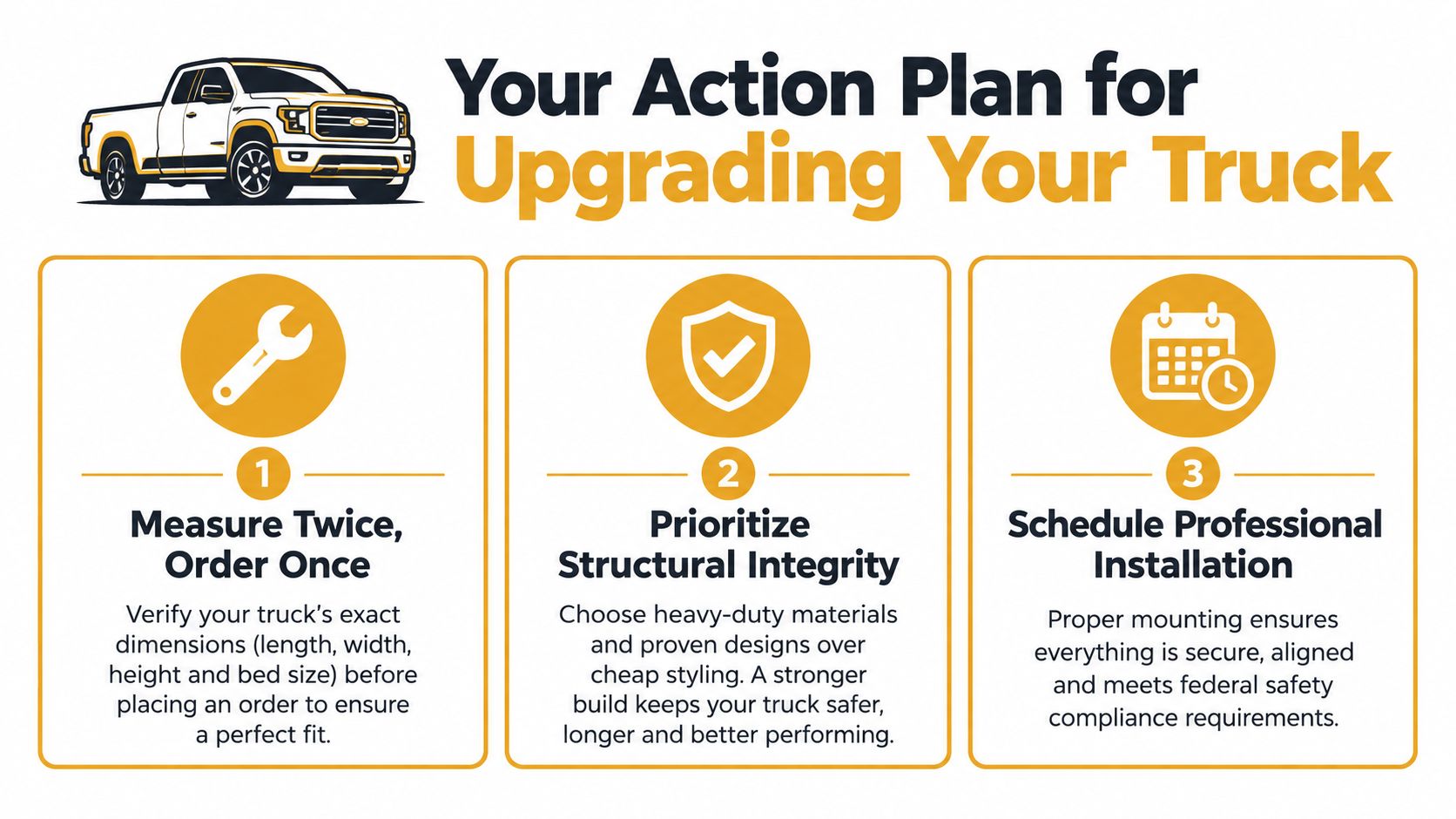
The smartest bumper job starts before the order goes in. Measure the front of the truck carefully, confirm the exact model year, and check every cutout the bumper needs. That includes tow hooks, fog lights, license plate space, and anything tied to sensors or brackets.
The checklist I'd use at the counter
- Measure twice, order once: confirm width, mounting points, and front-end clearance before money changes hands.
- Choose the right material: pick chrome-plated carbon steel, 430 stainless, or 304 stainless based on the routes the truck runs.
- Check the finish and thickness: make sure the bumper matches the job, not just the look.
- Plan the install: direct bolt-on fit saves time and reduces the chance of rework.
- Keep it clean: regular washing and inspection protect the finish and help you spot damage early.
A drop bumper deserves extra care. Check approach angle, frame clearance, and road clearance before you lock it in. A bumper that scrapes on every steep driveway looks cool for about five minutes, then becomes a headache every day after that.
If you're stocking the shop or upgrading your own rig, focus on parts that earn their keep. The right Kenworth bumper should fit cleanly, mount securely, and hold up long enough to justify the money.
Galhor Inc. builds configurable chrome bumpers for Class 8 trucks with direct bolt-on fitment, material choices that include chrome-plated carbon steel, 430 stainless, and 304 stainless, and support for real-world truck use. If you're ready to upgrade a Kenworth with a bumper that's built around fitment, finish, and uptime, visit Galhor Inc. and take a look at the options that match your truck and route.