

Stainless 304 Steel on Chrome Truck Bumpers
You just backed into a wet dock after a January run. Road brine coats the bumper on your Peterbilt 389 or Kenworth W900, and the truck sits overnight. The face still looks bright in the morning. The question is what steel sits under that chrome.
Stainless 304 steel is the grade owner-operators and fleet managers ask for when they want fewer bumper swaps and more days on the road. A weld, a drill hole, or a stone chip can change how long that shine lasts. Salt in a bracket pocket matters as much as the alloy name on the invoice.
Table of Contents
- Why Truck Bumpers Use Stainless 304 Steel
- Stainless 304 Steel Makeup in One Chart
- Strength Numbers Behind a Formed Bumper
- Road Salt Pits Welds and Repairs
- 304 Compared With 430 and Carbon Steel
- Fitment on Peterbilt Kenworth and Freightliner
- Choose 304 When Salt and Uptime Matter
- Stainless 304 Steel Bumper FAQs
Why Truck Bumpers Use Stainless 304 Steel
Two bumpers can match in the sun and fail on different clocks. One is carbon steel with chrome plate. The other is stainless 304 steel under the same plate. Shops call this grade 18/8. On a cert it is UNS S30400 or EN 1.4301, an austenitic chromium-nickel alloy. The name is the steel, not the shine.
That split shows up on Peterbilt, Kenworth, Freightliner, and International trucks that live in spray, snow, and dock rash. Chrome is the look buyers notice. The steel decides what happens when a stone breaks the plate or a bracket holds wet grit for a week.
Read the makeup chart first, so a listing that only says chrome does not fool you. Use the strength floors next when you compare a formed 18 inch drop bumper. Then look at salt, welds, and repairs, because a strong sheet can still pit. Last, match 304, 430, or carbon steel to the route and how long you will keep the truck.
You want fewer replacements, a professional face, and uptime after long hauls in harsh weather. I would not buy on mirror shine alone.
Stainless 304 Steel Makeup in One Chart
Start with the limits, then read them like a bumper buyer.
| Element | Limit | Bumper meaning |
|---|---|---|
| Chromium | 18.0–20.0% | Forms the thin self-repairing passive film |
| Nickel | 8.0–10.5% | Keeps the steel austenitic, tough, and more salt tolerant |
| Carbon | 0.08% maximum | Extra carbon can sensitize welds; 304L is about 0.03% max |
| Manganese | 2.00% maximum | Mill cap, not a shop choice |
| Silicon | 0.75% maximum | Mill cap |
| Phosphorus | 0.045% maximum | Mill cap |
| Sulfur | 0.030% maximum | Kept low for corrosion behavior and welds |
Penn Stainless lists stainless steel 304, UNS S30400, as 18/8 stainless because the standard range is 18.0–20.0% chromium and 8.0–10.5% nickel, with carbon at 0.08% maximum, manganese at 2.00%, silicon at 0.75%, phosphorus at 0.045%, and sulfur at 0.030%.
What you can act on
Chromium builds the thin passive oxide film. A light scratch in clean air can heal. Nickel keeps the structure austenitic, so the sheet stays tough when the mercury drops on a northern run.
Carbon is the row that bites after a repair. Standard 304 stops at 0.08%. 304L is the low-carbon cousin, about 0.03% carbon maximum, when a weld must resist sensitization. You do not pick manganese, silicon, phosphorus, or sulfur in the shop. Those are mill caps. If a quote cannot show this chart, you are not looking at documented 304.
Density is about 8,000 kg/m³. Treat that as a weight hint versus carbon sheet of the same thickness, not as a strength claim. The same published ASTM A240M values also cap hardness at 201 HB and 92 HRB. A premium price should match this chart on the spec sheet before you talk finish.
Shop check: On a Peterbilt 389 bumper or Kenworth W900 chrome bumper, confirm 304 is the base metal, not a marketing word painted over carbon steel.
Strength Numbers Behind a Formed Bumper
Quote the floors, then remember the bumper is more than the alloy label.
| Property | Figure | What it means on a bumper |
|---|---|---|
| Yield strength | 30,000 psi (205 MPa) minimum; coil about 190–240 MPa | Load before the sheet stays bent |
| Tensile strength | 75,000 psi (515 MPa) minimum; coil about 500–700 MPa | Pull-apart strength of the alloy, not the bolted bumper |
| Elongation | 40% minimum in 2 inches | Room to form steps, wings, and light openings |
| Hardness | 201 HB maximum; 92 HRB maximum | Annealed sheet forms; cold work hardens it |
| Elastic modulus | about 193 GPa | Alloy stiffness; ribs and thickness still set flex |
| Density | about 8,000 kg/m³ | Weight versus a carbon sheet of the same thickness |
For annealed 304 plate, sheet, and strip, published ASTM A240 minimums list 30,000 psi (205 MPa) yield, 75,000 psi (515 MPa) tensile strength, and 40% elongation in 2 inches. In 2026, Goodfellow listed coil yield at 190–240 MPa, and Goodfellow coil data listed tensile strength at 500–700 MPa. Real sheet sits in a band. There is no single magic number.
Forming versus a crash story
That 40% elongation is why shops can bend steps, wings, and light openings before the metal tears. Cold forming then raises strength and makes the next bend harder. Plan the hits in the press. Do not count on a second deep draw after the bumper is already work-hardened.
These figures are alloy minimums. They are not a crash rating for a finished 18 inch drop bumper. Thickness, ribs, brackets, weld quality, and frame bolts decide whether a dock, a stone, or a deer wins. Design checks should use the product standard and the temper you buy.
Elastic modulus near 193 GPa is alloy stiffness. Ribs and gauge still set how much the bumper flexes on the truck. A strong sheet can still pit if salt sits in a crevice. Strength and corrosion are different jobs.
Road Salt Pits Welds and Repairs
Stainless 304 steel is not corrosion-proof after a weld, a drill, or an impact repair. Chloride from road salt and brine breaks the passive film in pits and crevices. Dirt and moisture behind brackets, or inside fog-light cutouts, make it worse. A clean face can hide attack at a joint.
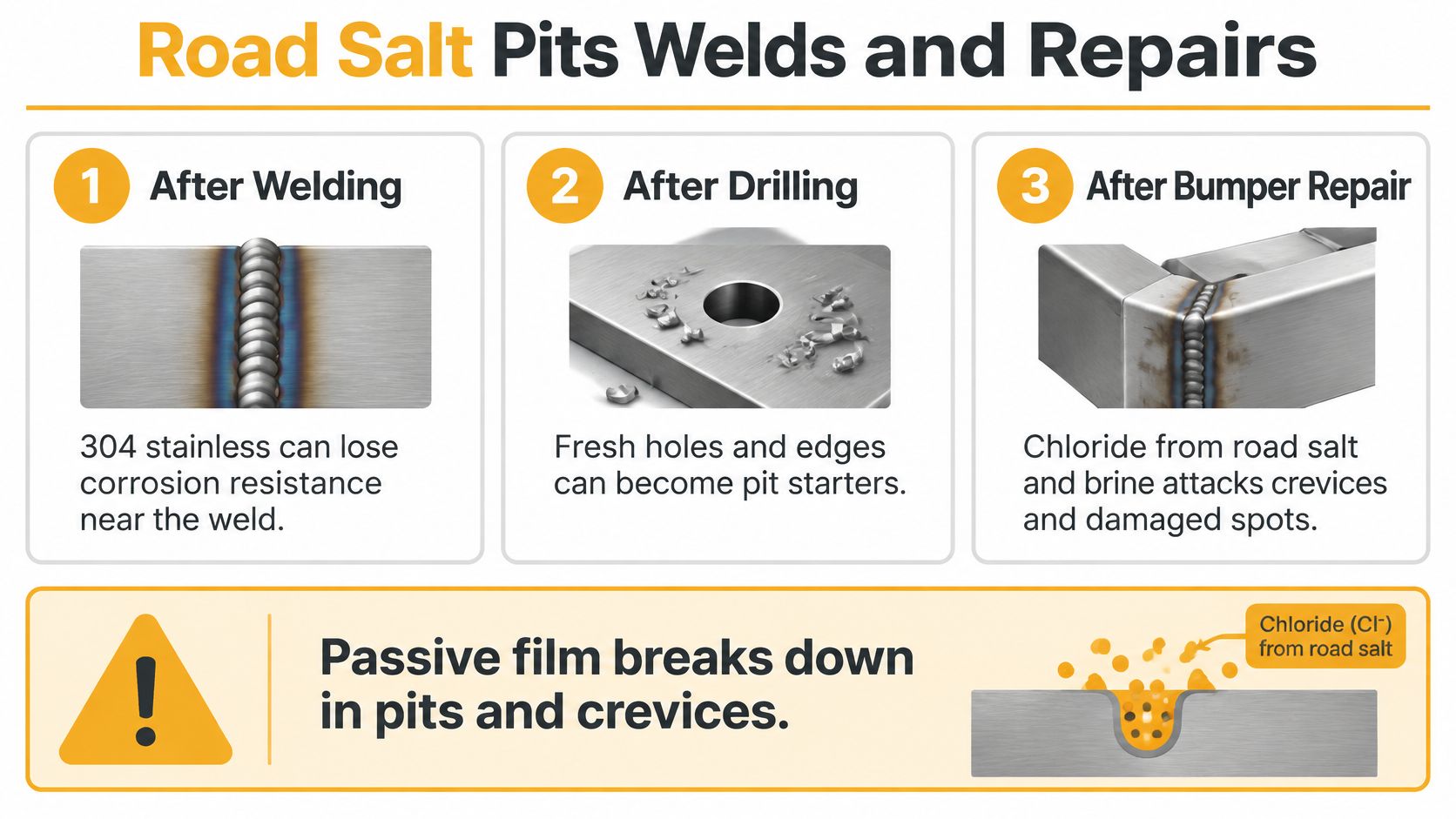
A 2025 peer-reviewed study found welded 304 kept surface integrity after 90 days in chloride from 50 to 300 mg/L, with intergranular corrosion sensitivity below 1% and corrosion rates below 0.005 mm/year. The same work found that higher chloride raised passivation current and cut corrosion resistance in both base metal and welds. Good lab behavior is not a free pass for a salted winter route.
Why a repair changes the steel
Weld heat can pull chromium into carbides at grain boundaries. Those boundaries then corrode easier. A fresh drilled hole is a new edge with no healed film yet. Grinding dust from carbon steel sticks and starts rust that looks like the stainless failed. A chip through chrome down to carbon steel is a different failure than a pit in 304. One eats the plate. The other eats the steel underneath.
Our guide to what corrosion resistance really means on a bumper is worth a read before you sign off a repair.
Yard steps that actually help
- Keep carbon tools off the face. No carbon-steel brushes, grinding dust, or rusty clamps on the bumper.
- Strip heat tint and iron after any weld or grind before the truck goes back out.
- Stop water traps. Brackets and cutouts should not hold a puddle against the steel.
- Rinse salt, including the back side, on northern and coastal routes. A polished face is not a wash.
- Restore the passive surface after a heavy repair so the film can rebuild in air.
- Use 304L on severe welded joints if sensitization is the worry. It does not stop chloride pitting.
Rinse the back of the bumper. The shine you see from the lot is not the surface salt attacks first.
304 Compared With 430 and Carbon Steel
The same mirror chrome can sit on three steels. You are buying the metal underneath.
| Base metal | Alloy character | Salted-road behavior | Form and weld | Best fit |
|---|---|---|---|---|
| 304 stainless | Austenitic; 18–20% chromium, 8–10.5% nickel | Strong general resistance; still pits in trapped chloride | High ductility and good welds; watch heat tint | Coastal, northern salt, long-retention premium chrome |
| 430 stainless | Ferritic; chromium with very little nickel | Medium; ahead of carbon, behind 304 in chlorides | Forms well and is magnetic | Mixed routes where cost and stainless both matter |
| Chrome-plated carbon | Plain carbon; protection is the plate | Very low once plate chips to bare steel | Easy to stamp; rust starts at chips and edges | Dry climates or short ownership, lowest upfront cost |
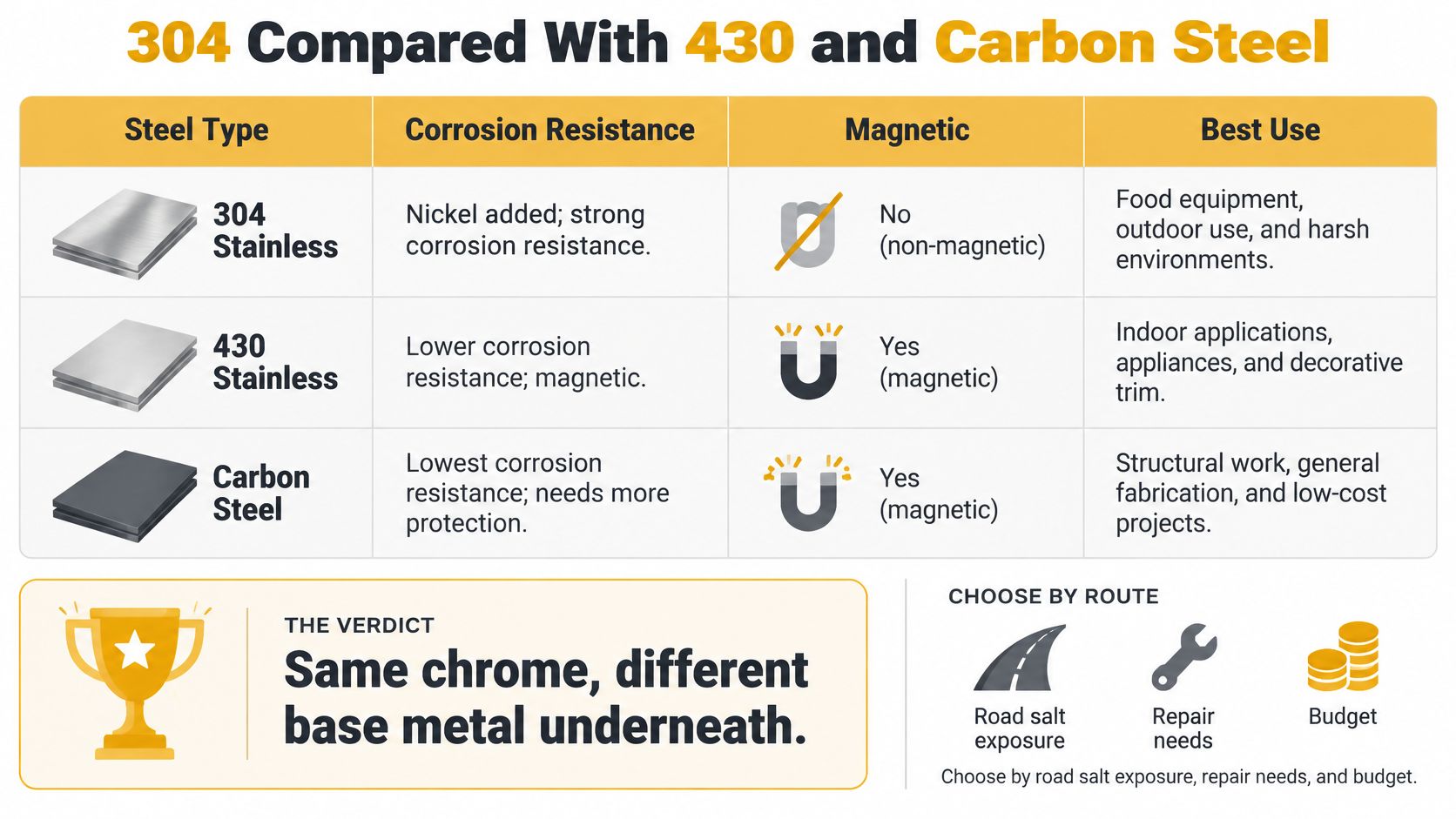
Pick by route, not by pride
304 brings nickel and an austenitic structure. That is the premium base when brine, coastal air, or many years in the fleet will test the bumper. You still wash it. You still watch crevices. You just start with more resistance when the plate is nicked.
430 is a ferritic stainless with chromium and very little nickel. Once chrome is damaged, it stays ahead of bare carbon. It is usually the middle spend. It forms well, and a magnet sticks to it.
Chrome-plated carbon looks right on day one and lives or dies by the plating. A stone chip to bare steel starts rust and can force an early swap. That is fine in a dry region or on a truck you will sell soon, if you accept more frequent replacement.
A fast magnet check
Annealed 304 is generally non-magnetic. 430 and carbon steel are magnetic. Heavy cold work can make 304 slightly magnetic, so a weak pull is not proof you were sold carbon. Pair the magnet with the spec sheet.
Fewer replacements and more days on the road can beat a cheaper invoice when the truck stays in salt for years.
Fitment on Peterbilt Kenworth and Freightliner
Fit is a truck-by-truck job, not a catalog slogan.
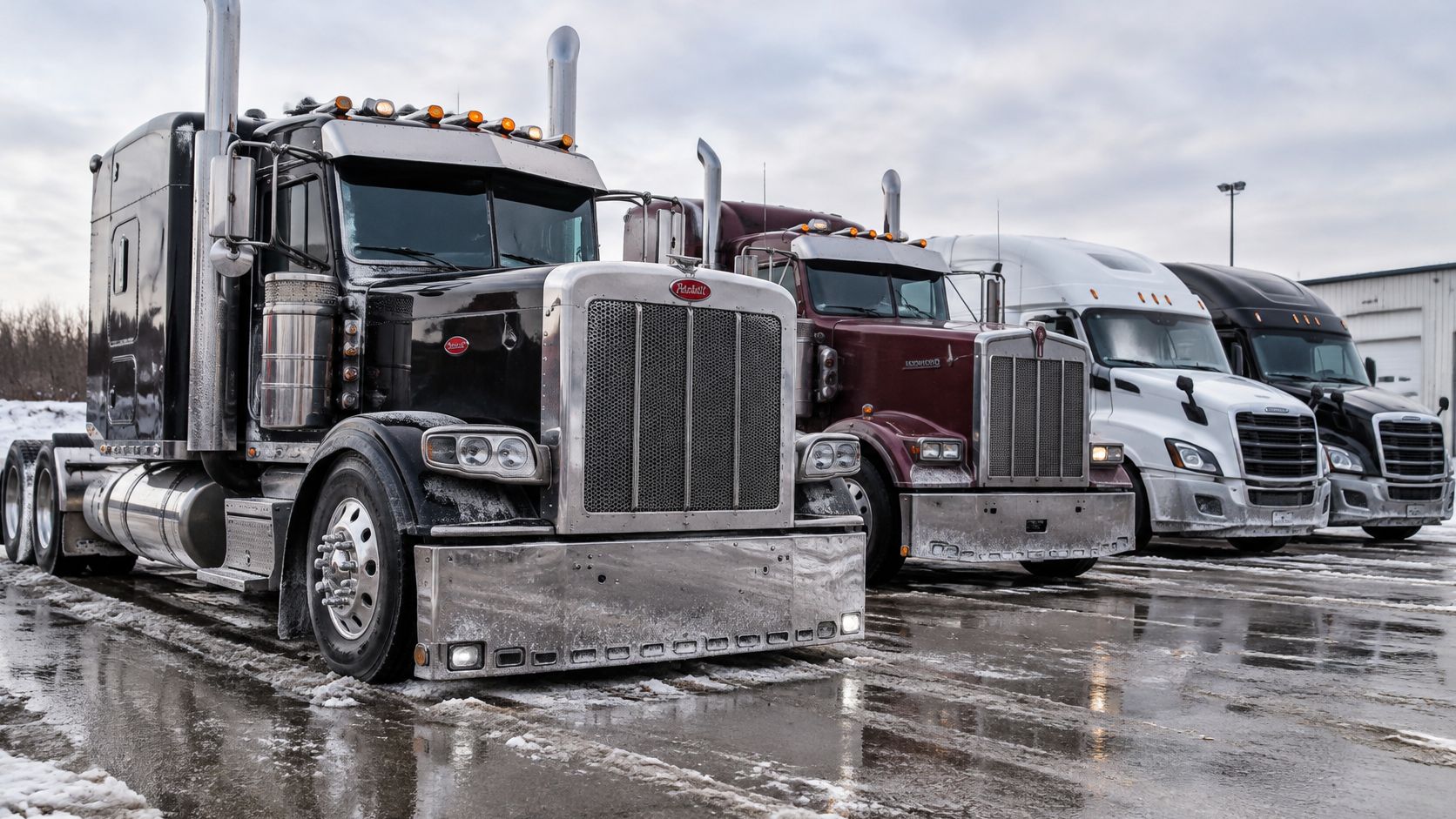
A Peterbilt 389 with an 18 inch drop bumper rides low in spray. Fog and light cutouts collect salt. The steel under the chrome, and the brackets that hold it, matter more than extra shine on the face.
A Kenworth W900 chrome bumper is a show face and a work face at the same time. Vibration and weekly washes punish thin plate over weak steel. If the mount rocks, polish will not save the corners.
Replacement trucks and regional rigs
A Freightliner Coronado or Columbia bumper swapped after a strike should match the model year. When the mount is right, it should bolt on without drilling or cutting. The order should name 304 or 430, not just chrome.
An International in regional haul picks up yard rash. Polish hides a scratch only until chloride sits in it. Spray, fit, and a named steel beat a mirror photo.
MakeItFrom notes that buyers comparing a Peterbilt 389 bumper, Kenworth W900 chrome bumper, or Freightliner replacement bumper should verify that 304 stainless is the actual base metal, not only the finish over carbon steel. UNS S30400 or EN 1.4301 is what you want on a mill cert. Our notes on choosing a semi truck bumper walk through style and mount choices before you order.
Order check
- Brand, model, and year: A close bumper from the wrong year still drills wrong.
- Standard or blind mount: Say which one the truck has.
- Cutouts: Lights and tags have to match the face you run.
- Named steel: If the listing says chrome only, ask what metal is underneath.
A direct bolt-on saves a shop day. Enthusiasts care about the mirror look. This check judges spray, fit, and whether the spec names the steel.
Choose 304 When Salt and Uptime Matter
Choose stainless 304 steel when the truck lives in road salt or coastal air, stays in service for years, and the bumper must stay bright while it takes hits. Choose a lower tier when the climate is dry and you will sell the truck soon.
Galhor builds chrome Class 8 bumpers in Texas for Freightliner, Peterbilt, Kenworth, and Volvo. The configurator covers brand, model, year, style, cutouts, and finish. All three material tiers share the same mirror-polished chrome. The difference is the steel. The 304 tier is the top line: higher nickel, salt tolerance for coastal rigs, heavier gauge, deeper chrome saturation, and a 5-year warranty on manufacturing defects.
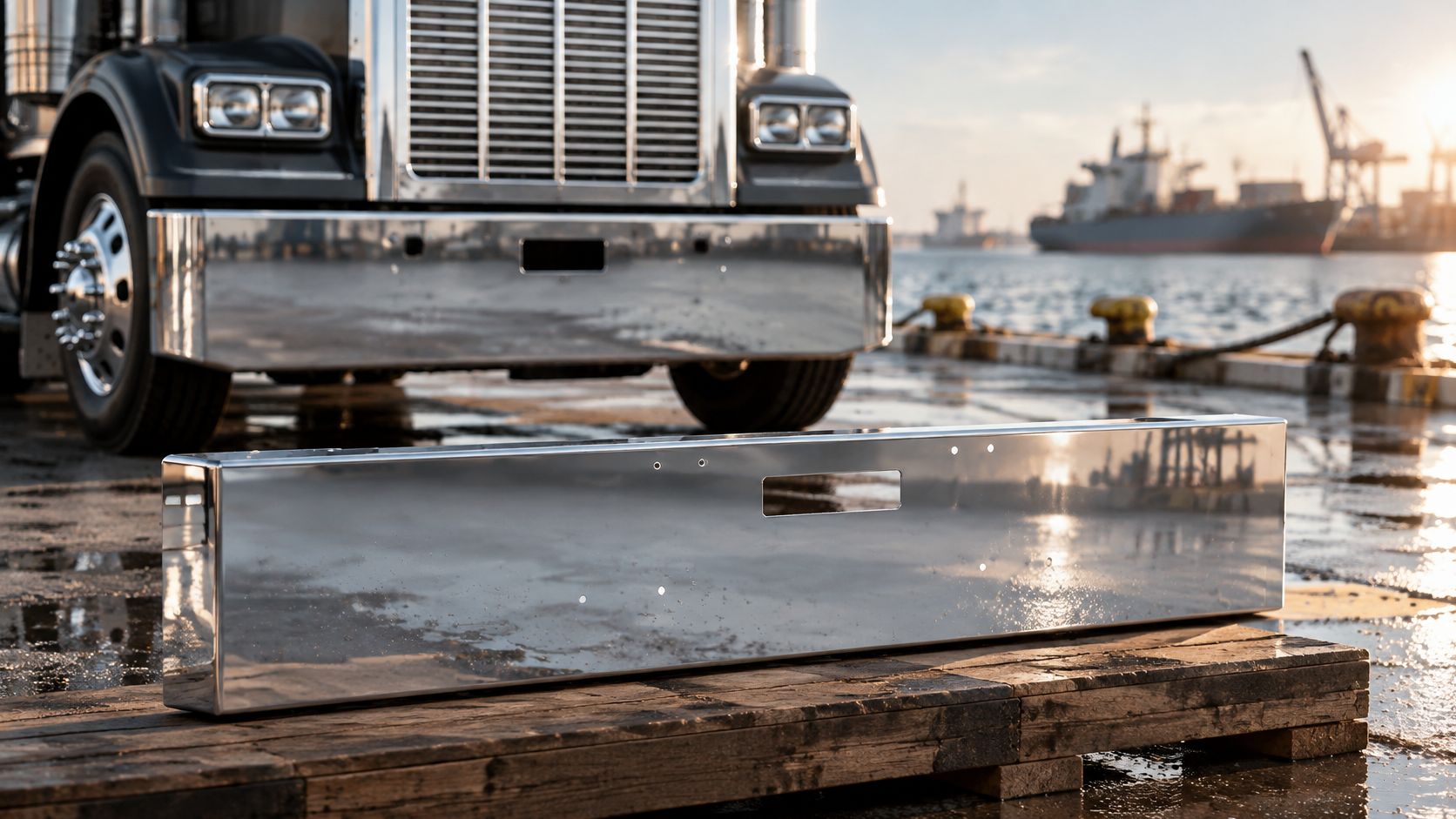
A Chrome bumper for Freightliner Classic is offered in 10-gauge chrome-plated steel or 3 mm chrome-plated stainless 304 or 430, with standard or blind mount and a direct bolt-on fit. No drilling or cutting. The chrome is a triple-layer process with 35 microns of nickel.
| Tier | Base metal | Ship time | Warranty | Best route |
|---|---|---|---|---|
| 304 stainless | 304 stainless steel | In stock, within 48 hours | 5-year, manufacturing defects | Coastal and salt-belt trucks |
| 430 stainless | 430 stainless steel | In stock, within 48 hours | 4-year, manufacturing defects | Mixed routes on a tighter budget |
| Chrome-plated carbon | Carbon steel | Made-to-order, typically 4–6 weeks | 2-year, manufacturing defects | Dry climates or short ownership |
In-stock stainless bumpers can ship within 48 hours across the United States. Made-to-order carbon units typically take 4–6 weeks. Warranty coverage is for manufacturing defects, not every stone chip. Rinsing salt still extends any bumper. Weigh that against total cost of ownership before you chase the lowest invoice.
Steel is U.S.-sourced. Engineering is in-house. Orders are supported from Magnolia, Texas. Match the truck in the configurator, pick 304 if salt and uptime are the priority, and order today instead of chasing rust next season.
Stainless 304 Steel Bumper FAQs
Is stainless 304 steel rust-proof
No. It resists general rust well. Road salt can still pit it in trapped moisture, behind brackets, and in cutouts. Wash the face and rinse salt on a regular schedule.
Does welding ruin 304
Not if you remove heat tint and iron and restore the surface after grinding or welding. Leave brown weld color and carbon dust, and the joint will not behave like clean sheet.
Is a 304 bumper magnetic
Annealed 304 is generally non-magnetic. 430 and carbon steel are magnetic. Heavy cold work can make 304 slightly magnetic, so use the spec sheet with the magnet.
How do I know it is solid 304
Ask for the base metal on the spec sheet. Confirm the UNS S30400 or EN 1.4301 designation. Chrome alone is not the answer.
Does the warranty cover stone chips
No. The warranty covers manufacturing defects, not road damage. A rock through the plate is on the route, not on the mill.
Which bumper fits my truck
Match brand, model, year, standard or blind mount, and cutouts in the configurator before you order. A direct bolt-on should not need drilling when those match.
How fast will it ship
In-stock stainless bumpers ship within 48 hours across the United States. Carbon bumpers built to order typically take longer.
Galhor Inc. builds chrome Class 8 bumpers in 304 stainless, 430 stainless, and carbon steel, with the same mirror chrome and a direct bolt-on fit for real trucks. If salt, welds, and uptime are why you are comparing bumpers, pick the steel that matches the route instead of the shine alone. Visit Galhor Inc. and set up your truck in the configurator today.