

Stainless Steel 430 vs 316: Which Truck Bumper Is Right?
“Always buy 316” is expensive advice if your truck runs dry inland lanes. “430 is just as good” is worse advice if you spend winter pulling through salt and brine. The right answer to stainless steel 430 vs 316 starts with your route, not the shine on a new bumper.
For owner-operators and fleet managers, the goal is a bumper that fits correctly, keeps a professional appearance, and doesn't create another shop visit. Grade matters, but so do thickness, brackets, finish damage, and whether the wash crew reaches behind the bumper.
Table of Contents
- Stainless Steel 430 vs 316 at a Glance
- Strength and Weldability for Bumper Builds
- Salt, Wet Service and Chrome Damage by Grade
- How to Run the 430 vs 316 Cost Break-Even
- Pick Your Grade by Route and Order Today
- Frequently Asked Questions About 430 and 316 Bumpers
Stainless Steel 430 vs 316 at a Glance
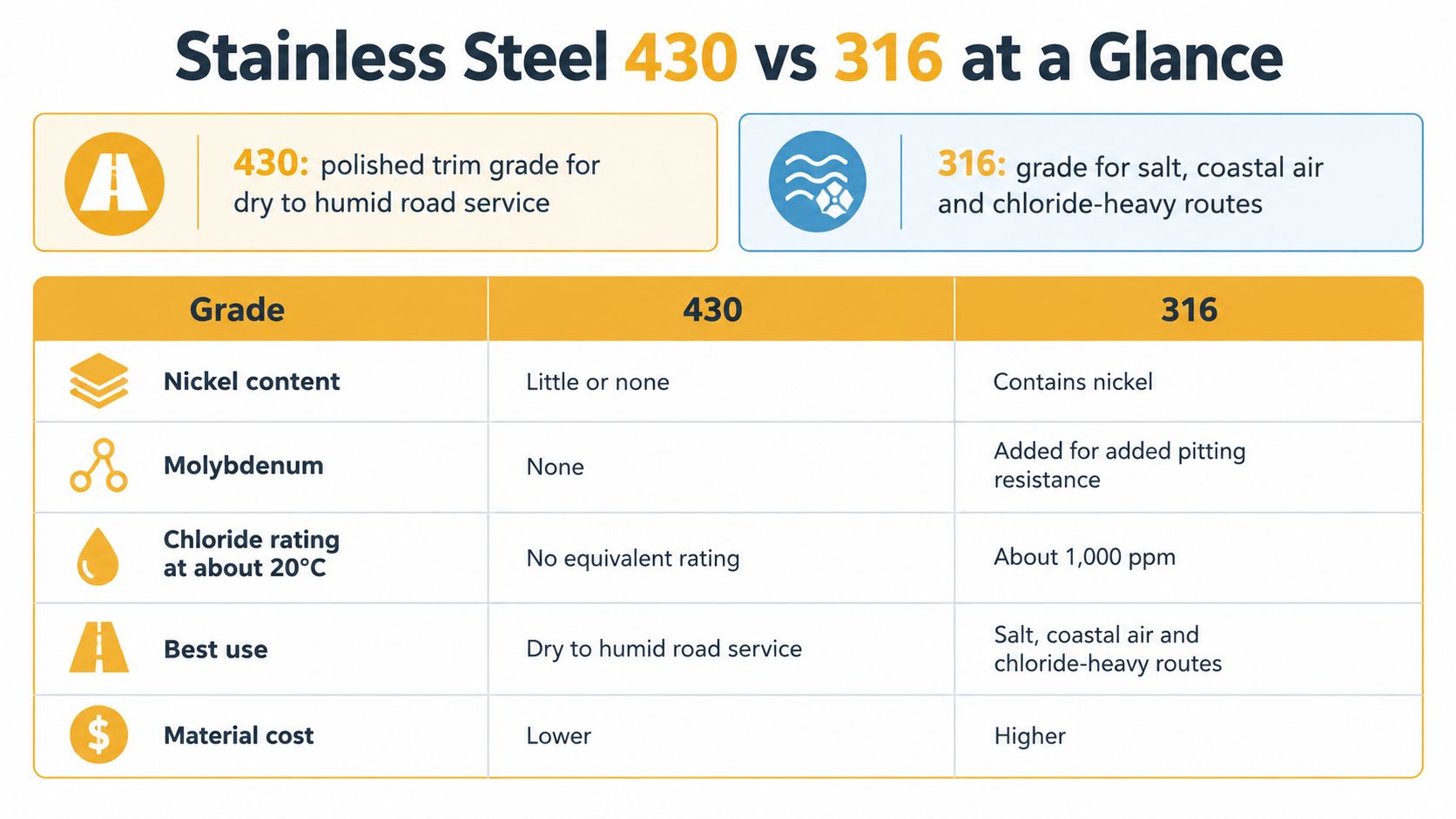
430 is a practical polished trim grade for dry to mildly humid road service. 316 is the stronger corrosion choice for salt, coastal air, and chloride-heavy routes. Neither recommendation excuses poor fitment or neglected maintenance.
SS 430 vs SS 316 Side-by-Side Specs
The composition ranges below come from the AISI stainless steel material sheet, which lists approximately 14–18% chromium for 430, compared with 16–18% chromium, 10–14% nickel, and 2–3% molybdenum for 316.
| Property | SS 430 | SS 316 |
|---|---|---|
| Grade family | Ferritic | Austenitic |
| Chromium | About 14–18% | 16–18% |
| Nickel | Little or none intentional | 10–14% |
| Molybdenum | None specified | 2–3% |
| Magnetic | Yes | Generally no in annealed condition |
| Hardenable by heat treatment | No | No |
| Relative material cost | Lower | Higher, with nickel and molybdenum |
| Typical bumper role | Polished trim in dry to humid road service | Salt, coastal, and chloride-heavy service |
Those alloy differences explain why two bumpers with similar mirror finishes can behave differently after salt reaches the metal. Molybdenum gives 316 added resistance to localized pitting and crevice corrosion, the damage that can start under deposits and around tight joints.
Nickel supports 316's austenitic structure and forming behavior, while its added alloy content raises material cost. Low-nickel 430 gives buyers a less costly material option without making it a corrosion-performance equivalent.
Buy the Material, Not Just the Shine
The Nickel Institute's stainless steel selection guide identifies 430 with highly polished trim in mild atmospheres. That's a useful starting point for a truck that stays inland, gets cleaned regularly, and doesn't carry salt deposits between washes.
A polished stainless bumper and a chrome-plated stainless bumper aren't the same finish. Polishing smooths the stainless itself. Chrome plating adds a separate coating system over the base material. Ask which construction you're buying rather than treating “chrome” as an alloy grade.
The practical guide to 430 stainless steel helps separate the material from the finish description.
Buying rule: Pay for corrosion resistance your route needs, but don't expect alloy grade to fix poor drainage or damaged plating.
Neither grade is rust-proof. For a route-based decision, use the operating-environment table under Pick Your Grade by Route and Order Today, then check the actual bumper construction before ordering.
Strength and Weldability for Bumper Builds
| Property | SS 430 | SS 316 |
|---|---|---|
| Density | 7.74 g/cm³ | Use the supplier's product-form specification |
| Ultimate tensile strength | 483 MPa | Require the certified value for the supplied condition |
| Yield strength | 310 MPa | Compare certified values in the same condition |
| Elongation | 25% in 2 in | More ductile; request the certified test value |
| Forming behavior | Adequate for formed trim; less forgiving on tight bends | More ductile; forms deeper and tighter |
| Weldability | Fair; needs controlled heat and can lose toughness near welds | Good with standard stainless welding methods |
The 430 values in this table come from the Elgin Stainless Steel 430 Fact Sheet: 7.74 g/cm³ density, 483 MPa ultimate tensile strength, 310 MPa yield strength, and 25% elongation in two inches. They describe that sheet's material condition, not every finished bumper carrying a 430 label.
What Strength Means on the Truck
430 isn't weak decorative foil. A fabricator can use it for formed, polished components and a properly engineered direct-bolt-on bumper. But a tensile-strength figure doesn't tell you whether a bumper will survive a loading-dock hit.
Thickness, bends, reinforcement, bracket layout, and bolt spacing determine how the assembly carries a load. A thicker, well-supported 430 bumper can outperform a thin, poorly supported 316 bumper in an impact. Neither grade designation is a crash rating.
316 gives fabricators more room for deep forming and tight shapes. Don't mistake that extra ductility for a blanket claim that every 316 bumper is stronger.
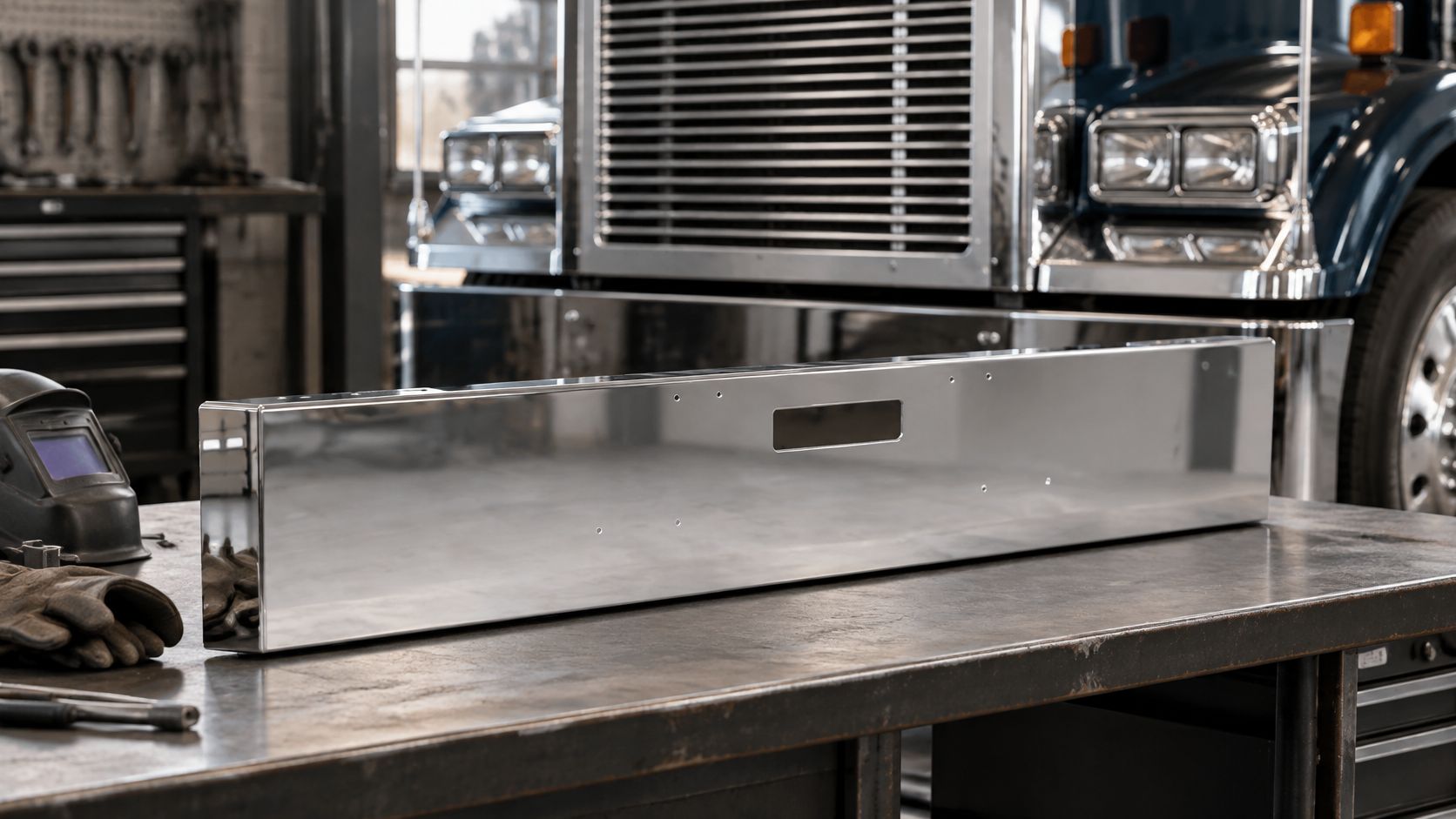
For a concrete construction example, the Chrome bumper for Freightliner Classic is listed with 10-gauge chrome-plated steel construction or 3 mm stainless steel 304/430 options. The catalog specifies standard or blind mounting and direct bolt-on Freightliner Classic fitment without drilling or cutting.
That listing shows why material and thickness must be checked together. Confirm the selected option on the order, not just the product photo.
Welding Needs More Than a Shiny Repair
430 requires careful heat control during welding. Excessive heat can reduce toughness and corrosion resistance near the joint, so a repair shop should clean the area first and use a qualified low-heat procedure.
316 generally works well with standard stainless welding methods, but weld contamination and poor finishing still cause trouble. A shop shouldn't weld through plating or use dirty tools that transfer carbon-steel debris onto stainless.
Before approving a repair, have the technician inspect bent brackets and stretched mounting holes. Repairing the face while leaving the support distorted doesn't restore the assembly.
Ask the supplier: What is the actual sheet thickness, where are the reinforcements, and what supports the mounting points?
Request thickness in inches or millimeters as well as gauge. That makes comparisons clearer when suppliers use different material types or gauge conventions.
Salt, Wet Service and Chrome Damage by Grade
A bumper can stay bright across its face while corrosion starts in a hidden pocket. Road salt, retained moisture, heat, and damage to the finish shape the risk, so inspect the areas that collect grime as closely as the visible surface.
For continuous exposure at about 20°C and neutral pH, Australian Stainless Steel Development Association guidance gives 316 a permissible chloride level of approximately 1,000 ppm, compared with approximately 200 ppm for 304. The guidance does not present 430 as equivalent for chloride service. Higher temperatures reduce allowable chloride levels, and above 60°C, 304 and 316 face a risk of sudden chloride stress-corrosion cracking.
These figures describe material-selection conditions, not a truck-bumper warranty or a guaranteed replacement schedule. A roadside salt reading cannot predict bumper life. The practical takeaway is that chlorides, heat, and retained moisture make material selection more demanding.
Why a Bright Bumper Can Pit in Small Spots
Road spray settles unevenly. Brine collects behind brackets, around fasteners, and along lower edges. As water evaporates, the remaining deposit becomes more concentrated.
A bumper may look bright across most of its face while small pits form beside a bolt head. The worst exposure can sit in a hidden pocket, beyond the area polished for display.
A dry-looking deposit can become wet again in fresh spray or humid air. Repeated wet-dry cycles keep the same spot exposed, and rinsing only the front face may leave the source in place.
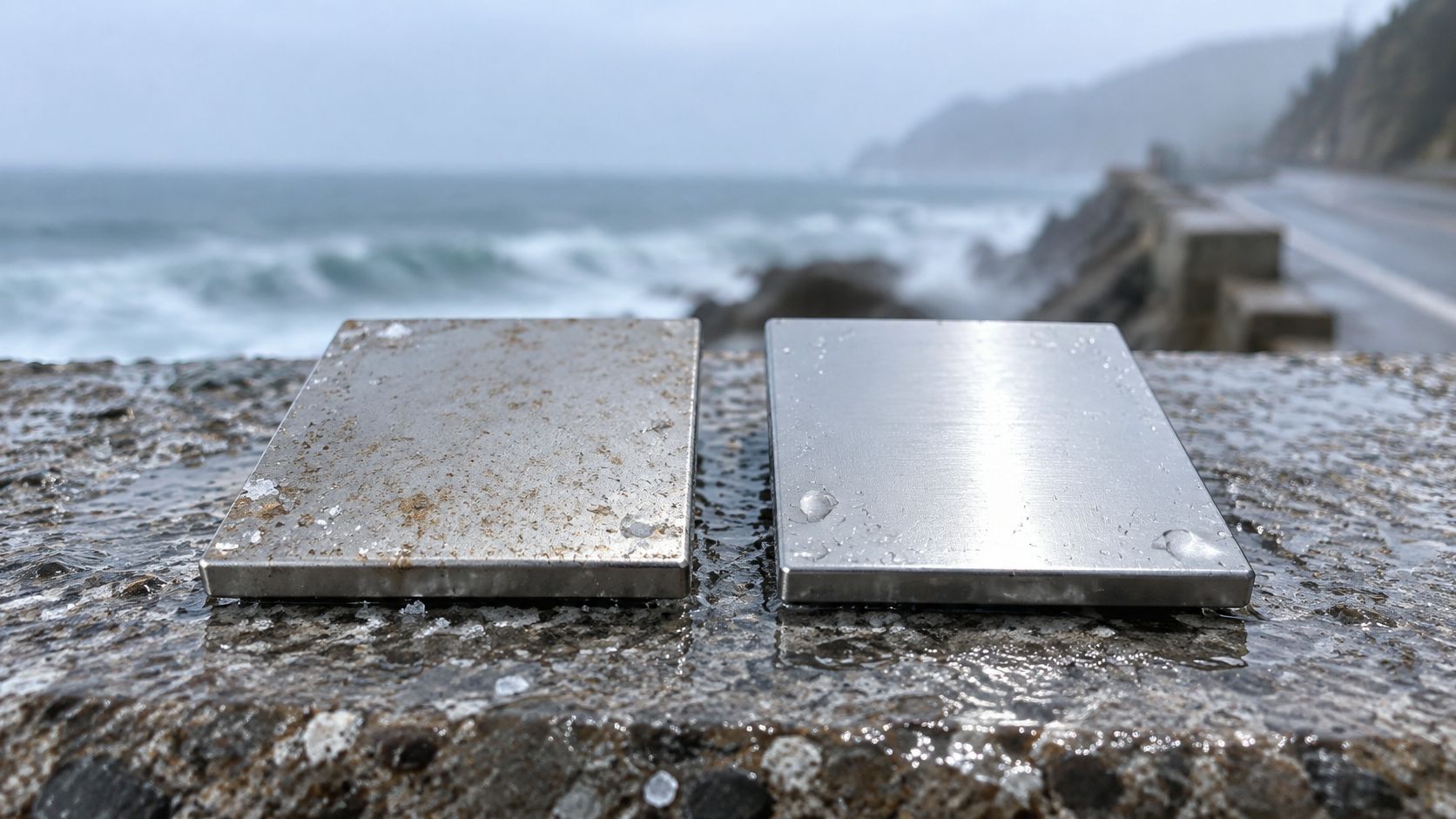
Clean, new 430 and 316 bumpers can look much alike. Appearance alone cannot show how either grade will handle salty grime trapped behind a light opening. Corrosion resistance describes how well a metal withstands its actual surroundings; it does not guarantee that every part of an assembly stays spotless.
Where Chrome Damage Starts
Inspect the areas most likely to be hit, cut, clamped, or bent:
- Stone chips: Look for breaks in the finish across the forward-facing surface.
- Bolt holes: Check under washers and around mounting slots where moisture can remain.
- Light cutouts: Inspect fog-light and accessory openings, including their rear edges.
- Weld seams and formed edges: Look for staining, roughness, or lifting finish.
- Dock-hit dents: Check the crease as well as the scrape. Bending can break the coating.
A plated bumper depends on both the coating and the base metal. The specified Galhor finish uses triple-layer hexavalent chrome over 35 microns of nickel, as detailed in the catalog construction described above. Once the coating is breached, the exposed substrate governs the material response. The coating does not make an exposed 430 substrate equivalent to 316. Even 316 can pit when exposure and surface damage are severe.
A tribocorrosion study comparing 430 with 316Ti found greater polarization resistance for 316Ti under its test conditions. That finding shows how wear and corrosion can interact. It is not a service-life rating for a finished 316 truck bumper.
A Wash and Inspection Routine That Reaches the Problem
- Rinse after winter runs. When practical, get fresh water onto the underside, rear face, and brackets within a few days. Do not leave packed brine in place until the next cosmetic detail.
- Inspect seasonal wear points. Check edges, bolt holes, light openings, and seams after the salt season. Inspect sooner after an impact or heavy gravel exposure.
- Address chips promptly. Clean and dry the area, then use a coating repair approved for the plated finish. Touch-up can seal a small breach, but it cannot recreate factory chrome.
- Keep drain paths open. Remove packed mud and debris. Check whether accessories, wiring, or added brackets have created a water pocket.
- Wash rather than dry-scrub. Flush away grit before using a soft wash mitt and a cleaner intended for the finish. Avoid aggressive abrasives and chloride-bearing cleaners.
Keep carbon-steel wire brushes away from the surface. They can scratch the finish and transfer iron onto stainless, creating another source of staining.
If washing does not remove a mark, inspect before polishing harder. A pit, lifted coating, and surface dirt need different treatment.
Repair decision: A small, stable chip may be worth sealing. Widespread lifting, deep pitting, or bent mounting areas call for a replacement quote.
When large areas of finish are damaged, replacement may be more practical than stripping and refinishing. Changing the grade gives you a better replacement, not a repair.
Before blaming the alloy, check three conditions: How often does the truck see salt? Does washing reach the back? Does water drain or pool? Laboratory corrosion results cannot predict bumper life without information about exposure, finish, geometry, and maintenance.
How to Run the 430 vs 316 Cost Break-Even
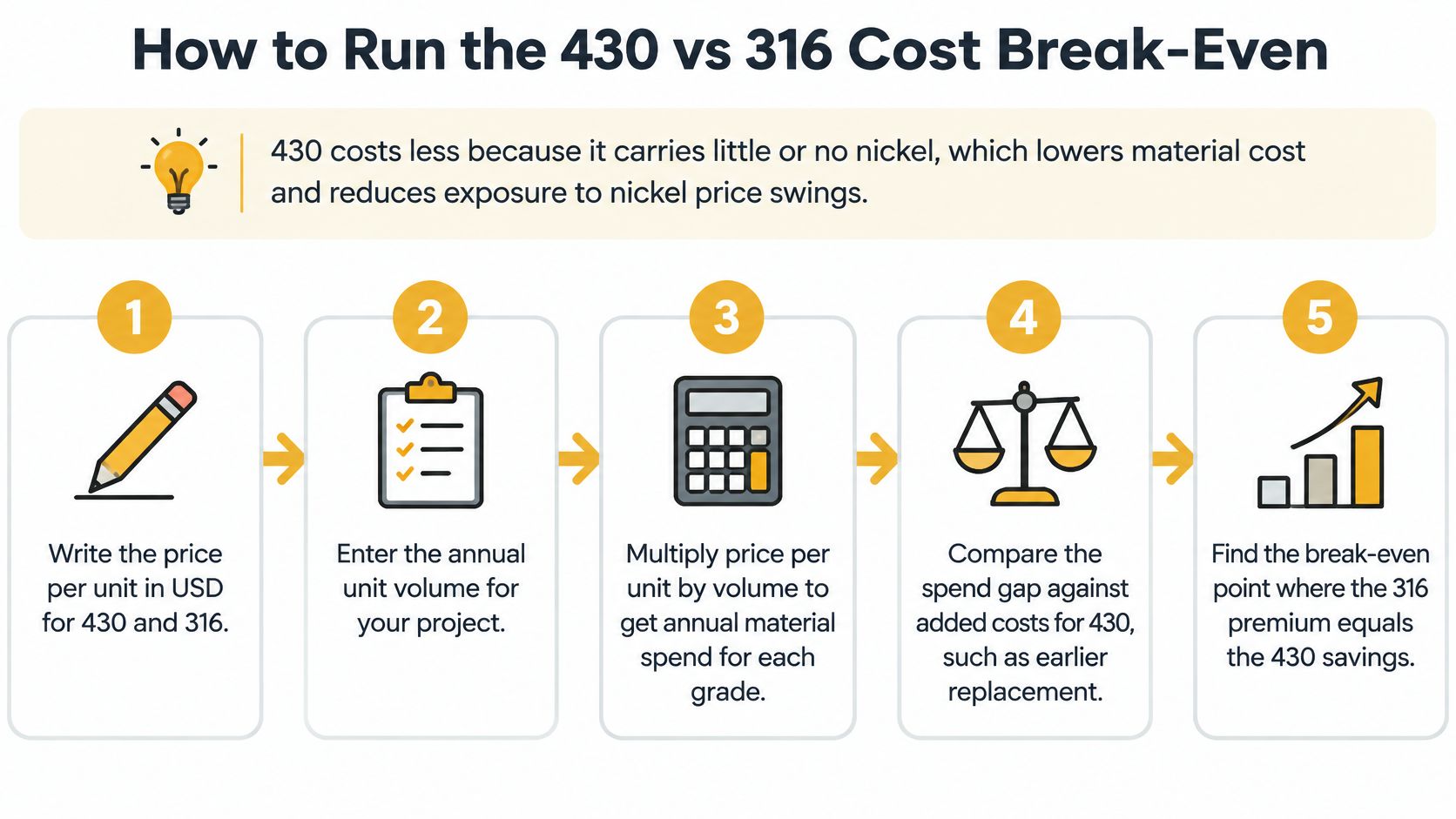
430 generally costs less because it carries little or no intentional nickel. The Stainlessinox technical guide describes the grade differences behind that trade-off: lower nickel content reduces alloy cost and nickel-price exposure, while 316 adds nickel and molybdenum for more demanding service.
The purchase-price gap is only the starting point. Your total cost of ownership also includes cleaning, repairs, replacement labor, freight, and productive time lost.
Use Quotes and Fleet Records
- Write down the installed price gap. Compare bumpers for the same truck make, model, year, style, thickness, cutouts, and mounting arrangement. Include freight so you're comparing delivered costs.
- Record your annual exposure. Note winter operation on treated roads, coastal work, splash exposure, and actual wash access. Route records are more useful than calling every truck “severe duty.”
- Name the failure you're trying to avoid. It might be cosmetic rejection, refinishing, or complete replacement. Use a shop quote that includes removal and installation.
- Add downtime correctly. Multiply hours out of service by an hourly downtime cost. If you track lost contribution per day, use days instead; don't multiply hours by a daily figure.
- Calculate the payback. Divide the added purchase cost for 316 by the expected annual cost it would avoid.
- Compare payback with ownership. Use the period you expect to keep that bumper, including any appearance standard you must meet before selling the truck.
- Make the choice. If credible savings repay the premium during ownership, 316 deserves the spend. If not, 430 may be the better buy with a funded wash and inspection plan.
Payback in years = added upfront cost ÷ expected annual avoided cost.
Don't Manufacture a Payback
The hard part isn't division. It's estimating which costs the material change would actually prevent.
Don't credit 316 with avoiding collision replacement, fixing a bad bracket, or eliminating washing. Don't count lost revenue and lost contribution as separate costs if they describe the same missed load.
If your records don't support a useful avoided-cost estimate, request quotes and track the next replacement cycle. There isn't a universal mileage threshold that makes 316 profitable.
Keep this comparison between 430 and 316. A 304 quote is a separate material decision, not a substitute value to drop into the calculation.
Pick Your Grade by Route and Order Today
A Peterbilt, Kenworth, Freightliner, or International badge doesn't change the metallurgy. Choose the material around the truck's work, then confirm that the bumper fits the chassis and your preferred style.
Best Grade by Route and Operating Environment
| Route or operation | Recommended grade | Why it matters |
|---|---|---|
| Dry or mildly humid inland lanes, washed regularly | SS 430 | Polished finish is practical and material cost stays lower |
| Snow-belt routes with road salt and brine | SS 316 | Molybdenum improves resistance to chloride pitting |
| Coastal runs with salt-laden air | SS 316 | Salt deposits can remain in wet pockets |
| Chemical or deicer hauling with frequent splash | SS 316 | Better chloride margin; verify compatibility with the actual chemical |
| Show trucks kept under cover in dry climates | SS 430 | Appearance and cost matter more than chloride margin |
| Mixed routes with seasonal winter salt and rare washing | SS 316 | More corrosion tolerance under retained salty deposits |
Published corrosion comparisons involving 430 and austenitic grades support exposure-specific selection rather than a universal service-life ranking. For chemical hauling, check the actual product carried; 316 isn't automatically suitable for every chemical splash.
Two Trucks, Two Sensible Choices
An owner-operator running Pennsylvania winters and Gulf Coast summers should treat the salt season as a major purchase factor. I would evaluate 316 first, especially if long hauls leave little time for a thorough wash.
A Kenworth W900 owner working dry Texas and Arizona lanes with weekly washing has a different case. 430 can deliver the bright appearance without paying for corrosion margin the route rarely needs.
For fleets, set a material standard by terminal or route group. That makes purchasing, inspections, and replacement records more consistent than letting each order default to the cheapest available bumper.
Confirm the Details Before Checkout
Whether you're shopping for a Peterbilt 389 bumper, a Kenworth W900 chrome bumper, or an 18 inch drop bumper, confirm the following:
- Truck identity: Match make, model, year, frame arrangement, and existing mounting hardware.
- Construction: Specify the base metal, actual thickness, reinforcement, and mounting style.
- Configuration: Check tow access, lights, sensor openings, plate position, and accessory cutouts.
- Clearance: Check a drop bumper against driveways, uneven yards, and the truck's working ride height.
- Installation: Verify bolt-hole alignment before tightening, and use suitable isolators between stainless parts and steel brackets where the mounting design calls for them.
Don't pull a misaligned bumper into place with the bolts. Find the cause, which may be a bent bracket, wrong configuration, or frame-fitment problem.
Match the Order to the Material Available
Galhor Inc., based in Magnolia, Texas, manufactures and retails chrome bumpers with 430 stainless, 304 stainless, and chrome-plated carbon-steel options. Its configurable ordering process sets brand, model, year, style, cutouts, and finish for direct bolt-on applications; confirm support for your exact truck before purchasing.
In-stock 430 and 304 flat bumpers can ship within 48 hours, while made-to-order carbon-steel units typically ship in 4–6 weeks. LTL freight is available across the United States, so confirm stock status, freight arrangements, and the expected delivery date before scheduling removal of your current bumper.
316 isn't among those listed material options. For heavy salt service, ask which available construction fits your route before ordering, and don't treat 304 as a direct equivalent to 316.
Configure the bumper, verify the grade and fitment, and order only after the specifications match the work.
Frequently Asked Questions About 430 and 316 Bumpers
Is Stainless 430 Magnetic, and Can a Magnet Identify It?
430 is magnetic, while annealed 316 generally is not. A magnet can narrow down the possibilities, but cold forming may make 316 slightly magnetic. Confirm the grade with supplier documentation.
Where Does 304 Fit Between Them?
For milder exposure, use 304. It offers general corrosion resistance but is not a 316 substitute for chloride service. Choose based on the route and salt exposure, not a supposed numerical ranking between 430 and 316 across all road conditions.
What Should I Ask the Supplier to Confirm?
Use the verification steps in the strength and weldability section for grade, thickness, and construction details. A mill certificate identifies the metal, not the completed bumper's reinforcement or mounting design.
Does a Chrome Finish Tell Me the Base Material?
The invoice should name both the substrate and finish. Chrome can cover carbon steel or stainless steel, and a mirror polish alone cannot identify the metal underneath.
Should I Upgrade the Alloy After Every Rust Problem?
First identify what failed: exposed base metal, trapped deposits, contamination, or damaged plating. Choose a replacement grade only after determining whether the rust came from the alloy or from the finish and service conditions.
Galhor Inc. offers configurable chrome bumpers in 430 stainless, 304 stainless, and carbon steel for supported heavy-duty truck applications. Visit Galhor Inc. to confirm material, thickness, fitment, and shipping schedule, then choose a bumper suited to your route.