

Tuner for a Truck: Types, MPG and Law
Forget the ad that says plug it in and save fuel. A tuner for a truck doesn't earn that label until your own lanes, loads, and driver prove it, and any file that shuts off emissions or stability systems isn't a performance option. It's a reject. I would judge every device on three things first: exact engine match, a clean stock rollback, and proof that EGR, DPF, SCR, and ESC still work as certified.
Table of Contents
- What a Tuner Changes on a Class 8 Truck
- Four Tuner Types Compared for Heavy Trucks
- Match the Tuner to Your Engine First
- Driveline Loads and Stability Checks
- Emissions Rules Warranty and Software Recovery
- Prove Fuel Savings Before You Trust the Tune
- Choose a Tuner or Leave the Truck Stock
What a Tuner Changes on a Class 8 Truck
Say an owner-operator runs a Peterbilt with a Cummins X15 on flat lanes all week, then takes a heavy load over grades on Friday. A tuner can make the pedal feel sharper on both runs, but that feel proves nothing about fuel. The first run, the second run, and the wind between them are three different tests.
In shop terms, a tuner for a truck is hardware or software that rewrites, or intercepts signals on the way to, the engine control module (ECM). It changes fuel quantity, injection timing, boost targets, and torque limits. Some files also change transmission shift points and torque converter or automated manual behavior.
What the ECM already controls
On a modern diesel in a Peterbilt, Kenworth, Freightliner, or International tractor, the ECM doesn't just chase power. It manages exhaust gas recirculation, the diesel particulate filter (DPF), and selective catalytic reduction (SCR) dosing and diagnostics. That's true whether the truck runs a Cummins X15 or ISX, Detroit DD13 or DD15, PACCAR MX-13, or International A26.
So the hard line is simple. If the main effect of the software is to turn those emissions systems off, mute their monitors, or stop a regen strategy from working, you're not looking at a smart economy tune. You're looking at defeat software with a friendly sales name.
Shop rule: Power you can feel is not proof. A calibration earns trust when it matches the engine, stays inside transmission limits, and survives a matched fuel test.
There's real money chasing these devices, which is why claims run hot. The Dataintelo global tuning-box market report valued the global tuning-box market at $1.8 billion in 2025, with commercial vehicles at about 38.6% of market revenue that year. A big market doesn't make a file right for your serial number.
Three questions sort the good from the junk. Which device type fits how you run? What load does it put on the driveline and stability systems? And can you prove any fuel change on your routes, with the stock file ready if the numbers don't move?
Four Tuner Types Compared for Heavy Trucks
Each tuner type makes a different trade-off between access, control, and reversibility. A device that is easy to unplug may still distort diagnostic data; a full flash gives more control but depends on a usable stock-file backup.
| Type | How it connects | What it changes | Back to stock | Best fit |
|---|---|---|---|---|
| Handheld monitor-tuner | OBD diagnostic port | Canned tunes and live gauges | Menu return to the saved stock file | Owner who wants gauges and an easy undo |
| OBD-II flash tool | Diagnostic port, file write | ECM fuel, timing, boost, and torque tables | Only if the original file was saved first | One tractor, owner or shop |
| Piggyback box | Inline on sensor or injector signals | Signals reported to the ECM, such as fuel, rail pressure, or boost | Unplug the box | Quick add-on, with greater diagnostic and tamper risk |
| Full ECU flash | In-vehicle or bench reflash | Maps, torque limits, and transmission commands | Only with the archived stock calibration | Fleet program with a written engine-family match |
Handheld monitor-tuner
A handheld plugs into the diagnostic port, loads a canned file, and can remain on the dash as a gauge pack. Depending on the device, it can display boost, exhaust gas temperature, fuel rate, rail pressure, coolant temperature, and DPF status. Those readings help a driver spot changes, but a gauge display does not prove the tune is safe or saves fuel.
Look for a device that saves the stock file before writing and provides a return-to-stock command. Keep the tool and cable in the truck so they are available if a shop needs to restore the original calibration.
OBD-II flash tool
An OBD-II flash tool uses the diagnostic port to read and write calibration files. A shop or owner can use it to change ECM fuel, timing, boost, and torque tables. The key protection is a saved copy of the original file. Without it, a clean return to stock may not be possible, regardless of the seller's promise.
Record the stock file name, date, and engine serial with the truck's service information.
Piggyback box
A piggyback sits between sensors and the ECM, altering the signals the computer receives. If it reports lower boost or rail pressure than the engine is producing, the ECM may add fuel or pressure to meet its targets. Unplugging the box restores the original signal path, but it does not erase the diagnostic uncertainty created while the box was connected.
False sensor readings can mislead fault-code checks and data logs. That complicates troubleshooting, especially when a driver or technician does not know the box was installed.
Full ECU flash
A full ECU flash rewrites maps in the truck or on a bench, including torque limits and transmission commands. For a fleet, require an archived stock file, a named engine-family match, and written confirmation that the torque curve stays within the transmission's rating. Bench work also takes the truck out of service, so schedule it around planned maintenance rather than a loaded dispatch.
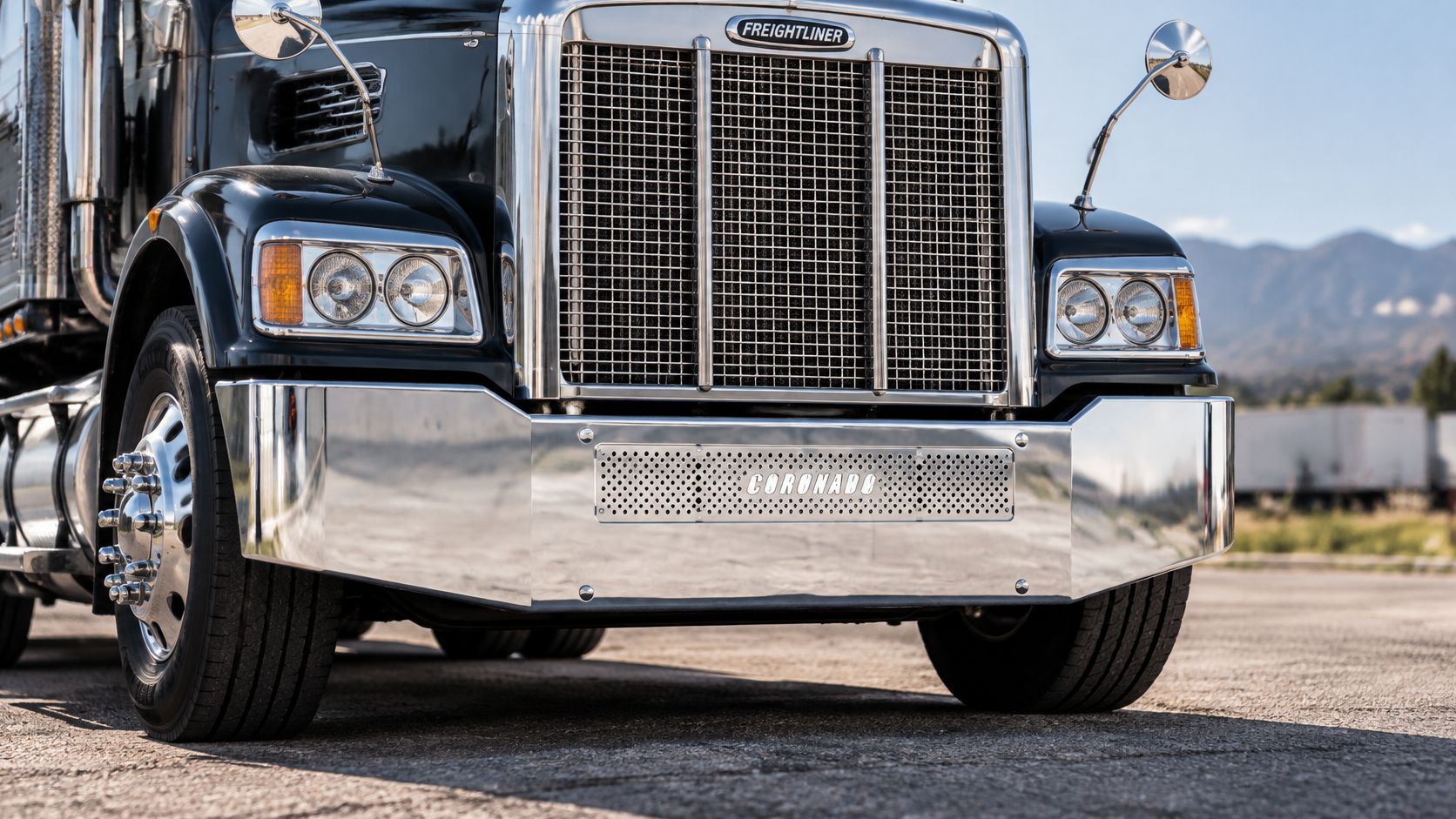
The Chrome bumper for Freightliner Coronado (2002–2009) is a named model-year application. Fitment matters for appearance parts just as engine-family matching matters for calibration.
Reject any tuner if the seller will not state plainly whether the calibration keeps EGR, DPF, and SCR within their certified strategy. Any calibration that defeats emissions controls or ESC is a reject, not a performance option. A fuel-saving claim also needs a matched before-and-after test; without one, treat it as unproven.
Match the Tuner to Your Engine First
Start with the engine, not the tuner. Each device is built for an engine family and a transmission, so the engine serial and transmission model decide what's even possible. A tuner that claims to fit all Class 8 trucks fails the first test.
| Engine | Verify before buying |
|---|---|
| Cummins X15 or ISX | Engine serial, stock file, and transmission torque rating |
| Detroit DD13 or DD15 | Engine serial, stock file, and transmission torque rating |
| PACCAR MX-13 | Engine serial, stock file, and transmission torque rating |
| International A26 | Engine serial, stock file, and transmission torque rating |
Pull the numbers off your truck
Get the engine serial from the engine data plate or your service records, not from memory. Add the model year, the transmission model, and its torque rating from the spec sheet or the transmission tag. Then have the shop read and save the stock calibration file before anyone talks about a new one.
That homework takes an hour. It prevents the classic failure where a file loads fine, drives fine for a week, then sets codes because it was built for a different calibration level in the same engine family. Same badge on the valve cover doesn't mean same software inside.
Make the vendor be specific
Ask the vendor to name the engine serial range the file covers. Ask for written confirmation that the torque curve stays within your transmission rating. If the answer is a generic list of truck brands, you're being sold a shelf file, not a matched calibration.
- One file per engine family: Mixed fleets need a separate, documented file for each platform, never one shared file across Peterbilt, Kenworth, Freightliner, and International trucks.
- Older model years: Confirm the vendor still supports your exact calibration before you order, including what happens after a dealer update.
- Paper trail: Keep the serial, file name, and date with the truck's maintenance records so the next tech knows what's loaded.
If a vendor can't tie the file to your engine serial and transmission rating, the product isn't matched. It's just available.
Driveline Loads and Stability Checks
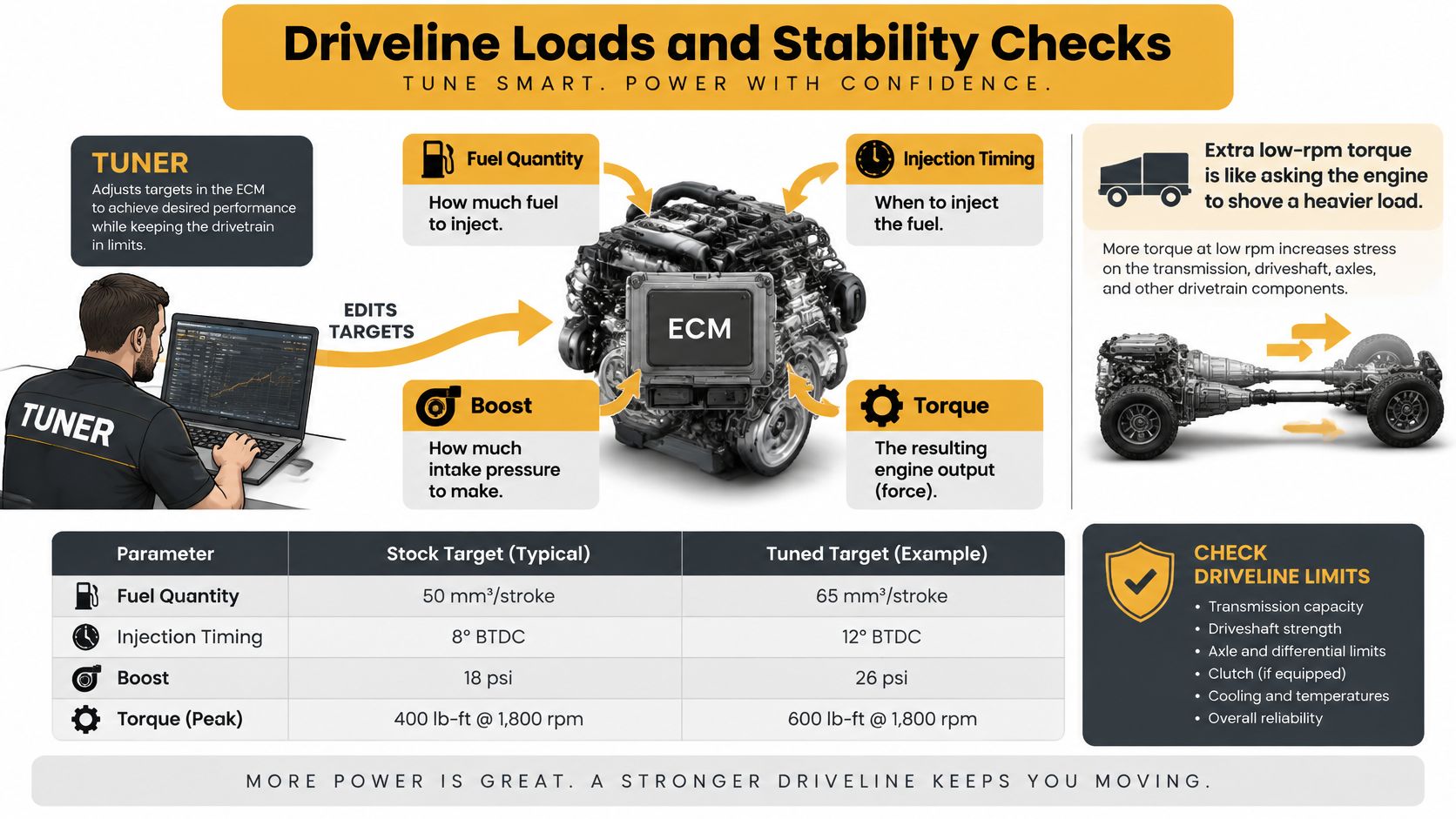
The ECM sets fuel quantity, injection timing, boost, and torque on every power stroke. A tuner edits those targets. The EPA tampering enforcement policy describes a truck tuner as changing ECM calibration by modifying fuel injection, torque limits, boost targets, and transmission-control commands, and it flags software tuners as potential defeat devices when the main effect is to bypass emissions controls.
Now picture what added low-rpm torque does in metal. It's like asking the engine to shove a heavier load through the clutch at every takeoff. Cylinder pressure rises, so the clutch, gear teeth, differential, and driveshaft all see more force than the design sheet assumed, and aftertreatment dosing and exhaust heat shift with it.
Wear shows up where the torque lands
A calibration past the design envelope doesn't usually break parts on day one. It speeds up wear in the clutch, transmission, differential, and aftertreatment system, then bills you later as downtime. That's why the useful spec isn't a claimed horsepower gain. It's documented compatibility with the engine family, transmission torque rating, DPF and SCR operating strategy, and diagnostic monitors.
Watch commanded versus actual numbers after any flash. If actual boost overshoots the command, or rail pressure hunts instead of tracking, the file and the hardware aren't agreeing. Stop there and fix it before the truck goes back under load.
The stability system is watching torque too
Electronic stability control is not a separate world from the engine. The NHTSA-hosted manufacturer guidance on ESC covers qualifying three-axle tractors under FMVSS 136, generally those with a steer-axle GAWR of 14,600 pounds or less and combined driven-axle GAWR of 45,000 pounds or less, built after August 1, 2017. ESC reads wheel speed, yaw rate, steering angle, brake pressure, engine torque, and trailer data to decide when to cut torque or apply brakes.
Change how fast torque arrives, or drop the brake-to-engine torque-cut messages, and that timing can shift. The truck may intervene too early on a ramp or too late in a real event. This is safety hardware with national weight behind it. The Congressional Research Service report on heavy truck safety cites federal estimates that the ESC requirement could prevent about 1,400 to 1,700 crashes a year. A tune that fights that system is not a small add-on.
Run the acceptance test in order
- Save the stock calibration and store a copy off the truck.
- Scan for fault codes before and after the flash, and record both results.
- Confirm ESC, ABS, and torque-reduction messages are online and functional.
- Check cruise control and engine brake behavior at normal road speeds.
- Compare commanded versus actual boost and rail pressure under load.
- Road-test loaded, or run a loaded dyno pull, and watch exhaust temps and shift quality.
- Approve more trucks only when traces stay in limits on the first one.
Reject any file that disables emissions diagnostics, ESC communication, or safety-related torque control. There's no version of that trade that favors uptime. A truck parked for a driveline failure or a stability fault earns nothing, no matter what the dyno sheet said.
Emissions Rules Warranty and Software Recovery
The enforcement record is not theory. In its 2019 EPA enforcement summary on tampering, the agency reported it had resolved more than 30 cases involving more than 1 million aftermarket defeat devices in the preceding years. Heavy trucks were right in the middle of it.
One Wisconsin service-truck repair and refrigeration company sold or installed ECM tuning products on 202 heavy-duty diesel trucks. A Minnesota trucking company removed or disabled emissions controls on 22 trucks. Those aren't pickup stories from a forum. They're fleet cases with fleet consequences.
Your goal doesn't change the exposure
Horsepower, fuel economy, or drivability. The stated goal doesn't matter if the product bypasses or renders EGR, DPF, or SCR inoperative. Civil penalties, inspection failures, and downtime sit on the truck and its owner, not only on the seller who took your card.
That includes hardware tricks sold as temporary. A delete pipe, a simulator box, or a file that blocks DPF regens all land in the same place at inspection. If you're comparing exhaust work while you sort this out, our guide to DPF exhaust systems covers how the filter fits into the full aftertreatment path.
Warranty in plain shop terms
A dealer can deny an engine or aftertreatment claim when the calibration sits outside the certified file. So ask in writing whether the tune is emissions-intact and whether the normal OEM software update path still works afterward. Verbal comfort at the counter won't help you during a claim review.
Then cover the service risks the ads skip.
- Stock file custody: Who holds the original calibration, and can you get it the same day?
- Dealer updates: Does a manufacturer software update erase the tune, conflict with it, or lock the ECM?
- Access control: Is diagnostic-port access protected, and are any logins documented for your shop?
- Roadside recovery: How fast can a shop in another state return the truck to stock with the records you carry?
A mixed fleet of Peterbilt, Kenworth, and Freightliner model years should not share one mystery file. Reject vendors who can't name the engine serial coverage. Reject anyone who tells a driver to ignore a permanent diagnostic trouble code and keep rolling.
Prove Fuel Savings Before You Trust the Tune
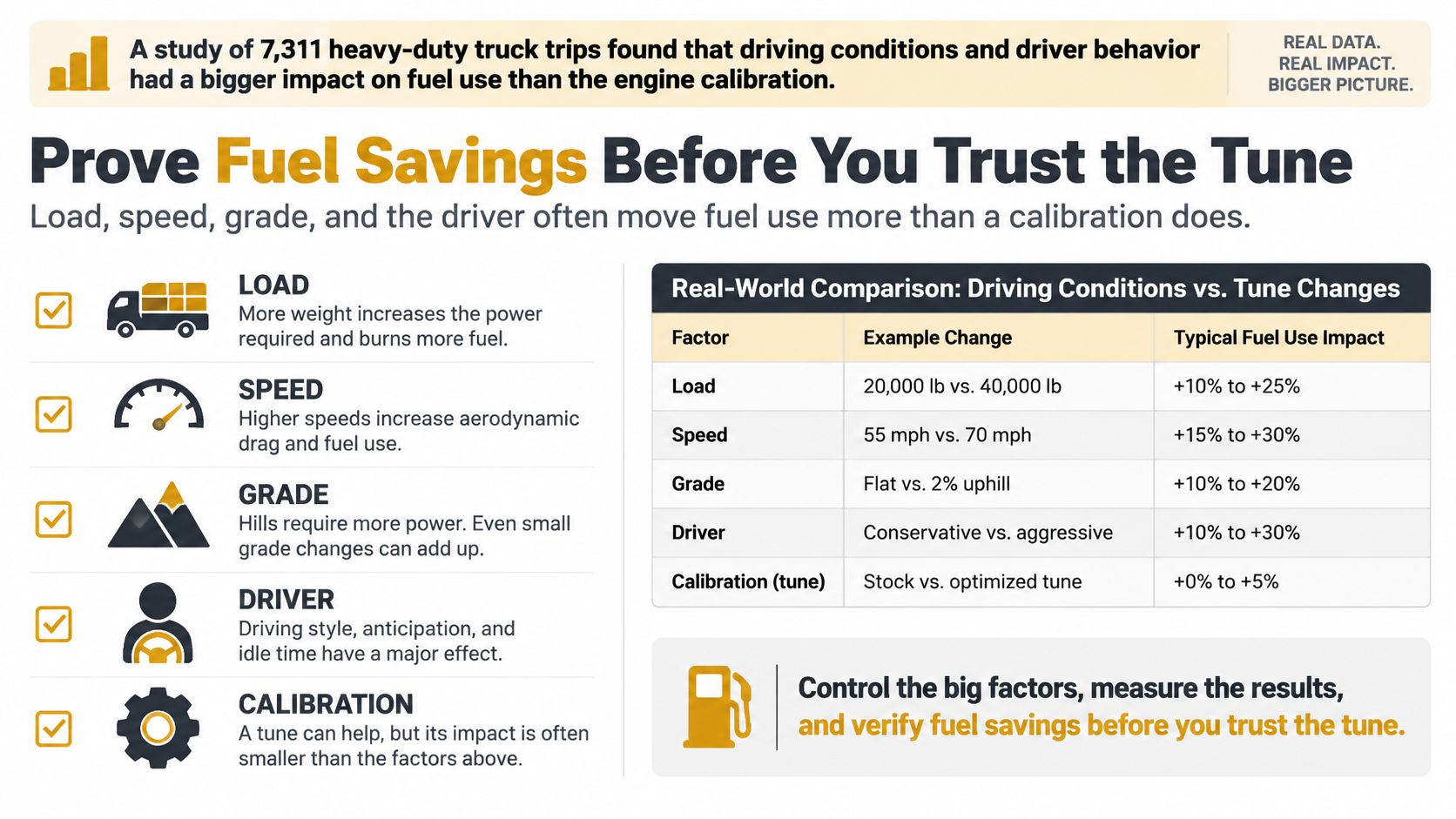
Universal MPG claims are the weakest sales pitch in this business. Load, speed, grade, and the driver often move fuel use more than a calibration does. A tuner works inside that reality, not above it.
The Energy journal study indexed by RePEc used data from 7,311 in-use heavy-duty diesel trucks and found load rate has a clear positive effect on fuel consumption, while the importance of driving behavior changes with loading conditions. A separate telematics model explained 85.8% of fuel-consumption variability using average speed, gross vehicle weight, and road gradient. Above 80 km/h, keeping engine speed within the economical range reduced consumption.
Stop mixing up three different tools
An ECM calibration changes what the engine is told to do. Driver coaching changes how the person in the seat uses the pedal, the gears, and cruise. A telematics speed policy changes the operating envelope for everyone. Each can save fuel, but you can't credit the tuner for savings that came from slowing the fleet down.
Tires belong in that same honest accounting. Low pressure raises rolling resistance on every mile, tuned or not, and our overview of a semi tire pressure monitoring system explains how fleets keep pressures visible before they cost fuel.
The 30-day test that actually means something
- Log 30 days of baseline on your normal lanes with the stock file.
- Record payload bands, idle minutes, tire condition, weather, and fuel source for each run.
- Install the tune with the stock file saved and ready to restore.
- Run a matched 30 days, same lanes and same driver where you can.
- Report cost per mile, not peak horsepower and not one good tank.
- Roll back if cost per mile doesn't improve or if new fault codes show up.
One great week proves nothing. Weather, a light load, and a tailwind can hand any truck a great week.
Watch the edge cases. A mountain lane won't match a flat I-10 run, so never compare across them. A tune that only helps on empty miles can lose money when the trailer sits at gross weight, which is where most revenue miles happen.
My blunt verdict is this. When loads and routes change every day, better shift points, disciplined speed, and less idle time can beat a tuner on measured cost per mile. Buy the calibration only if your own matched numbers say it adds something on top of those basics.
Choose a Tuner or Leave the Truck Stock
Buy a tuner only when three things are true at once. The device matches your engine and transmission on paper, the calibration leaves EGR, DPF, SCR, and ESC working, and you can restore the stock file the same day. If any one of those fails, leave the truck stock and chase fuel with speed, idle, and tires.
Four situations four answers
One owner-operator who wants gauges and a reversible file. A handheld that saves the stock calibration and keeps emissions monitors alive fits. You get live data every mile and a clean undo in the cab.
One truck with a real economy complaint on flat lanes. An OBD flash makes sense only after the 30-day baseline is already logged. Without that baseline, you'll never know if the file helped or the season changed.
A fleet adding trucks over time. Go one engine family at a time, with a written torque limit per transmission. Skip shared piggyback boxes a driver can unplug, because your records stop meaning anything. Before any fleet rollout, check how calibration changes interact with coverage in our Class 8 truck warranty guide.
Any seller offering a delete. A DPF-off switch, an EGR block file, or a tune that clears ESC faults is a walk-away. There's no discount that covers penalties, failed inspections, and a truck that can't be serviced normally.
Do this paperwork this week
Pull the engine serial, transmission model, and model year for your Peterbilt, Kenworth, Freightliner, or International. Ask the vendor for stock-file backup, emissions-intact confirmation, and a straight answer on dealer updates. Don't install anything until those answers are in writing and the rollback tool rides on the truck.
When your truck's software is sorted, give the front end the same exact-fit treatment with a direct bolt-on chrome bumper built for your make, model, and year. Galhor builds bumpers for Peterbilt, Kenworth, Freightliner, and Volvo tractors, with options for models like the Peterbilt 389 and Kenworth W900 configured for real long-haul use. Order now and upgrade your truck today by building yours at Galhor Inc..